
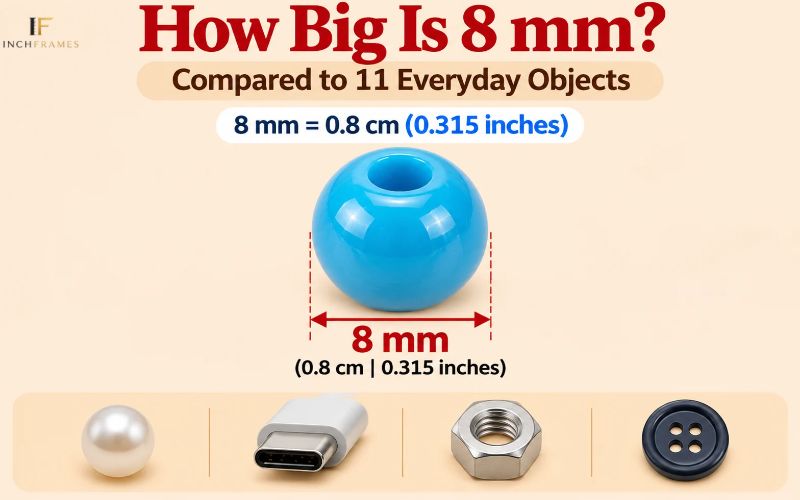
8 millimeters (mm) is a very small measurement, but it is bigger than you might think when you see it next to an everyday object. It equals 0.8 centimeters, 0.315 inches, or just under one-third of an inch. If you look at a standard ruler, 8 mm is the distance between the 0 mark and the eighth small millimeter line.
To picture this size without a ruler, think about a small button, a craft bead, or the width of a slim pencil. These objects can help you get a better feel for the measurement.
Although 8 mm is less than 1 centimeter, it can make a noticeable difference when you are choosing a small part, checking a hole, buying craft supplies, or measuring something at home. Let’s look at 11 familiar objects that can help you understand how big 8 mm really is.
How Big Is 8 Millimeters, Really?
Eight millimeters is a short distance that measures four-fifths of a centimeter. Imagine dividing a 1 cm space into ten equal parts. Each part would be 1 mm, so 8 mm covers eight of those parts.
It is also a little less than one-third of an inch. If you have an inch marked on a ruler, 8 mm reaches about 31.5% of that distance.
This measurement is useful when looking at small parts and narrow spaces. For example, a slim gap between two pieces of furniture or a small opening in a plastic fitting may be close to this size.
You may not notice a difference of just 1 or 2 mm at first, but it can matter when two parts need to fit together. That is why understanding this small measurement can be surprisingly useful.
8 mm in Real-World Use
You may come across 8 mm when working with small hardware, craft supplies, or household repairs. For example, an M8 bolt has a nominal thread diameter of 8 mm. This measurement helps you choose a matching nut or other fitting.
It can also appear in jewellery and craft work. Beads are often sold in different sizes, including 6 mm, 8 mm, and 10 mm. The difference between them may look small in a product photo, but it becomes easier to see when they are placed side by side.
When shopping for small parts, check whether the stated size refers to the width, diameter, thickness, or length. These measurements describe different things.
Everyday Things That Are About 8 mm in Size
The easiest way to picture 8 mm is to compare it with objects you can hold or see around you. Some items have a dimension close to 8 mm, while others are useful examples of a similar size.
The table below shows 11 everyday references. Remember that natural objects and manufactured items can vary, so use these as visual guides rather than exact measuring tools.
| Everyday Object | Approximate Measurement |
|---|---|
| Small craft bead | 8 mm |
| Slim wooden pencil | 8 mm |
| USB-C connector | 8 mm |
| M8 bolt | 8 mm |
| Small shirt button | 8 mm |
| Small pearl bead | 8 mm |
| Green pea | 8 mm |
| Small pom-pom | 8 mm |
| Narrow watch strap | 8 mm |
| Small round earring stud | 8 mm |
| Short rice grain | 8 mm |
A Small Craft Bead
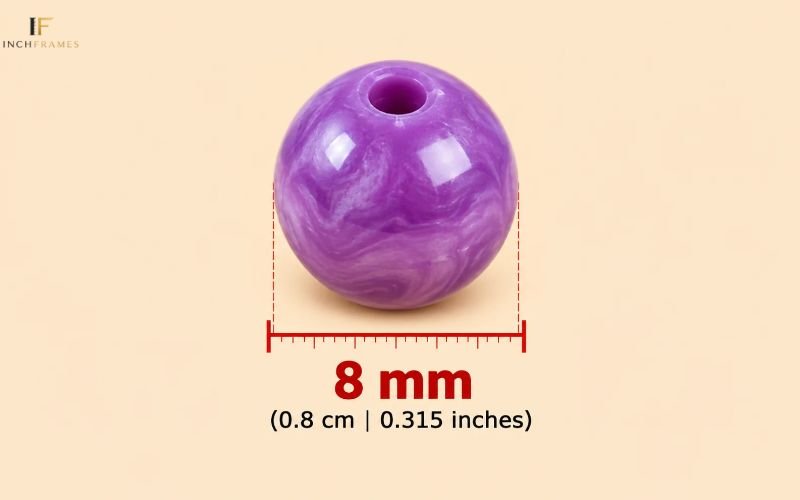
An 8 mm craft bead is one of the easiest ways to understand this measurement. These small beads are commonly used in bracelets, necklaces, children’s craft projects, and decorative work.
When you hold one between your fingers, you can see that it is quite small. It is not as tiny as a seed, but it does not take up much space either. Its round shape makes it a useful example because you can look at its diameter from one side to the other.
Craft beads are sold in several sizes, such as 4 mm, 6 mm, 8 mm, and 10 mm. If you place an 8 mm bead beside a 10 mm bead, the difference becomes easier to notice.
A Slim Wooden Pencil
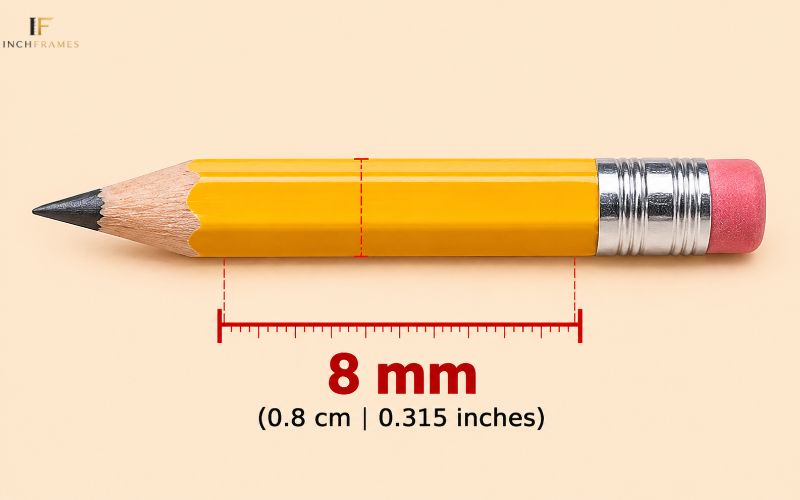
A slim wooden pencil can have a body diameter of around 8 mm, although pencil sizes vary by design and manufacturer.
Take an ordinary wooden pencil and look at its width from one flat side to the opposite side. You may find that it is close to 8 mm. This gives you a familiar object to use when imagining the measurement.
Pencils are useful references because most people have handled them many times. You can find them in school bags, desk drawers, classrooms, and offices.
Keep in mind that a thick drawing pencil or a chunky triangular pencil may be wider. A regular slim wooden pencil is a better comparison for this small measurement.
Related Post: How Big Is 7 mm? Compared to 10 Everyday Objects
A USB-C Connector
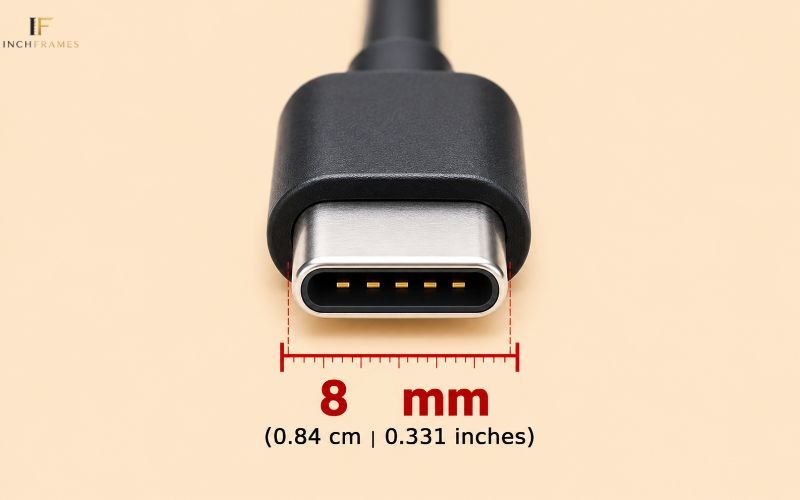
A USB-C connector is another helpful reference. The metal end of a standard USB-C plug is approximately 8.4 mm wide, making it slightly wider than 8 mm.
You may recognise this connector from modern phones, tablets, headphones, and other electronic devices. It has a small oval shape and can be plugged in either way up.
Look at the metal tip rather than the plastic cable behind it. The metal part is the section that gives you a useful comparison.
The difference between 8 mm and 8.4 mm is only 0.4 mm, so they are very close in size. Most people would find it difficult to judge that small difference just by looking.
An M8 Bolt
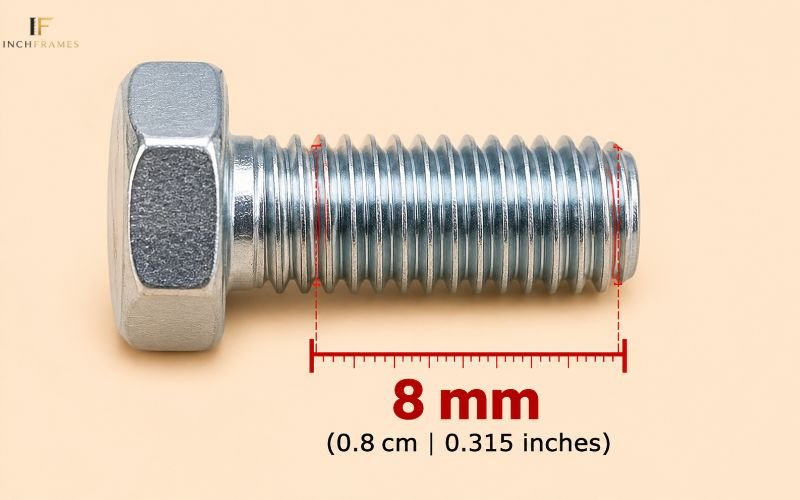
An M8 bolt provides one of the most accurate examples of an 8 mm measurement. The letter M refers to a metric thread, while the number 8 refers to its nominal thread diameter of 8 mm.
You may see these bolts in furniture fittings, machinery, metal brackets, and home repair kits. They are used to hold two or more parts together.
Look at the threaded section of the bolt. Its outside diameter is designed around the 8 mm size. This is different from measuring the bolt head, which may be much wider.
If you are buying a replacement bolt, check its length and thread details as well. The M8 label tells you the nominal thread size, not the total length of the bolt.
A Small Shirt Button
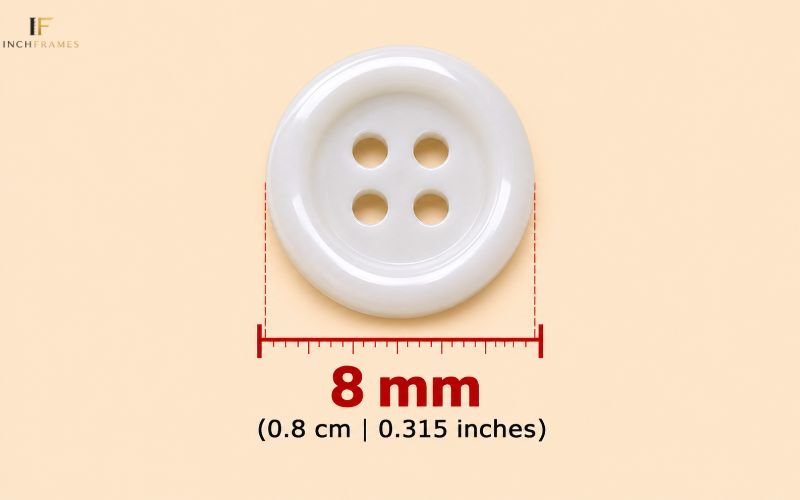
Some small shirt buttons measure close to 8 mm across. You can find buttons of this size on shirts, children’s clothing, cuffs, and other garments.
A button is a simple object to use as a size reference because its round shape makes the width easy to picture. Place it flat on a table and look from one outer edge to the other. That distance is its diameter.
Not every shirt button is 8 mm. Many are larger, especially the buttons used on the front of adult shirts and coats. Small buttons are the better comparison here.
If you have a sewing kit at home, check its smallest buttons. You may already have one that is close to this measurement.
A Small Pearl Bead
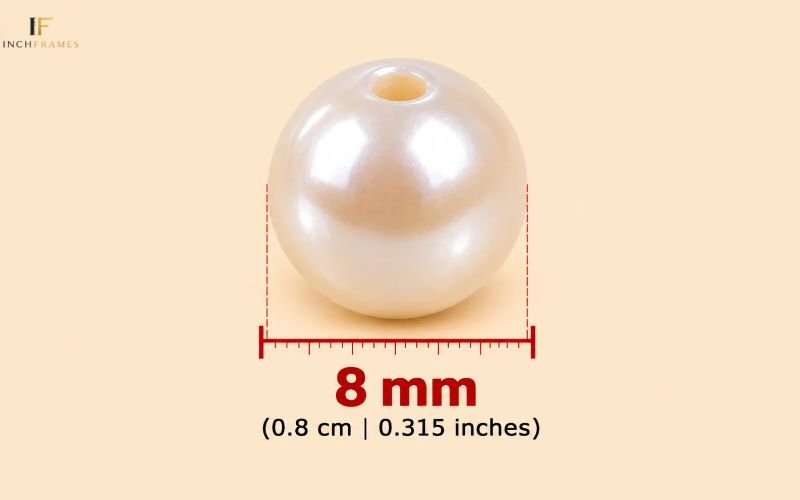
An 8 mm pearl bead is a useful example for anyone interested in jewellery. Pearl beads are sold in several standard sizes, and 8 mm is a common option for necklaces, bracelets, and earrings.
Its rounded shape helps you picture the distance from one side to the other. When you hold it in your hand, it looks like a small round decorative piece rather than a large bead.
Pearl beads may be natural, cultured, or imitation. Their appearance can differ, but an advertised 8 mm bead should have a diameter close to that measurement.
One thing to remember is that a pearl bead may not be perfectly round. Small differences in shape can affect how wide it looks from different angles.
Related Post: How Big Is 5 mm? Compared to 13 Everyday Objects
A Green Pea
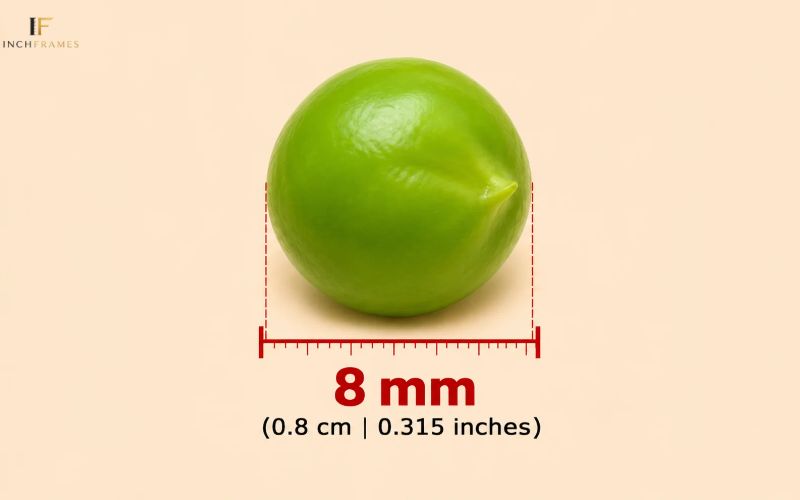
A green pea can give you a natural comparison for a measurement close to 8 mm. Many peas are around 7–9 mm across, although their size depends on the variety and how fully they have grown.
Take one pea from a bowl and look at its widest part. You will notice that it is small enough to fit comfortably between your fingertips.
Peas are easy to recognise, so you do not need any special knowledge to use them as a reference. You may see them in frozen vegetable bags, fresh produce sections, or on your dinner plate.
Since peas are natural foods, they do not all have the same size. Some are smaller, while others grow larger than 8 mm.
A Small Craft Pom-Pom
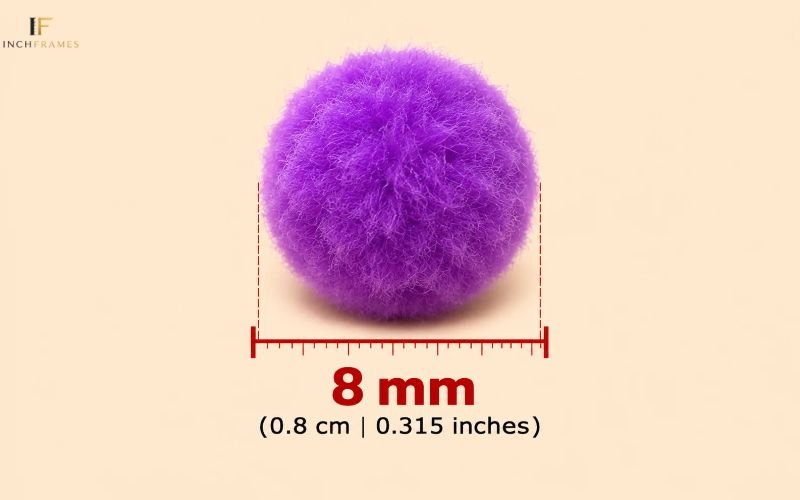
Small craft pom-poms are often sold in different diameters, including sizes close to 8 mm. They are made from soft fibres and are used in school projects, decorations, greeting cards, and handmade designs.
An 8 mm pom-pom is tiny enough to sit between your fingertips. Its round shape gives you a simple way to picture the width of the measurement.
You might find these in craft shops or in mixed bags of decorative supplies. They come in many colours, so you can easily separate them by size when working on a project.
Unlike a hard bead, a pom-pom can be squeezed. This means its shape may change slightly when you press it, so compare it without applying pressure.
A Narrow Watch Strap
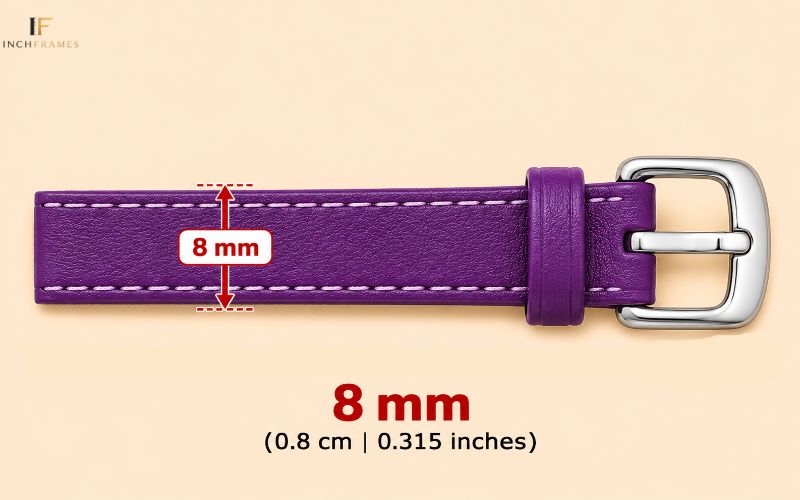
Some narrow watch straps are made in an 8 mm width. This size is more common in certain slim watches and small designs than in larger everyday watch bands.
To picture the measurement, look at the width of the strap from one long edge to the other. An 8 mm strap is quite narrow compared with many standard watch bands.
Watch straps are often available in several widths, so it is worth checking the product details before buying a replacement. A strap that is only slightly too wide may not fit the watch properly.
Also, do not confuse strap width with strap thickness. Width is measured across the band, while thickness describes how deep it is from the front to the back.
A Small Round Earring Stud
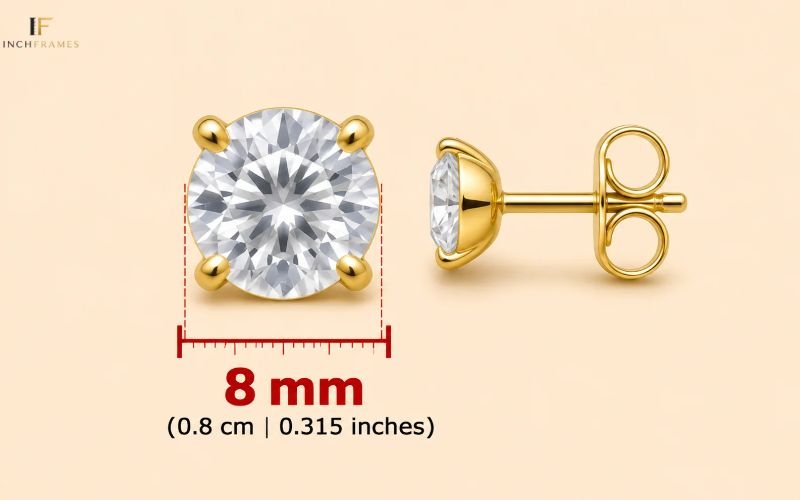
A small round earring stud can measure around 8 mm across. This is a useful visual reference because the front part of the earring is usually round and easy to compare with other small objects.
You may see this size in simple fashion earrings, decorative studs, and some small jewellery designs. It is large enough to be visible without looking like an oversized accessory.
When checking the size, focus on the decorative front rather than the metal post that goes through the ear. The post is much thinner and has a different measurement.
Earring sizes vary widely. Some studs are only a few millimeters across, while others have larger decorative faces. An 8 mm design sits in the small-to-medium range for many styles.
Related Post: How Long Is 4 Inches? Compared to 12 Everyday Objects
A Short Rice Grain
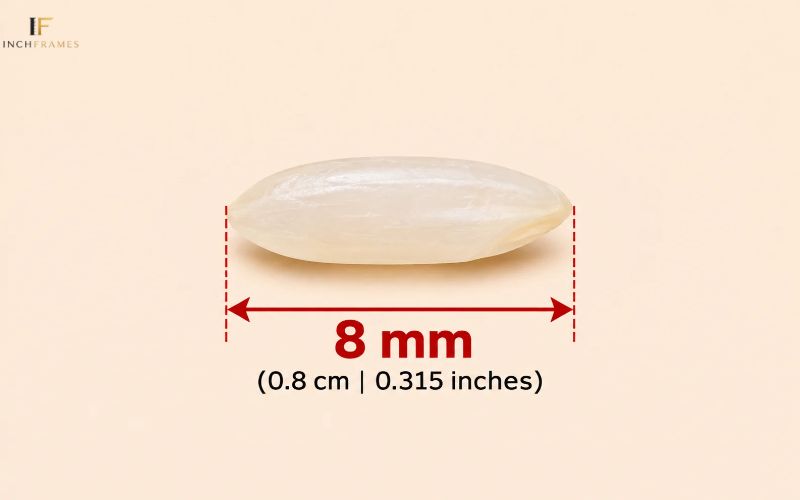
A short grain of rice can help you picture a length close to 8 mm. Many rice grains are longer than this, but some short-grain varieties measure around 6–8 mm in length.
Place a grain on a flat surface and look from one end to the other. Its length gives you a simple comparison for a distance of about 8 mm.
Rice is something you may already have in your kitchen, which makes it an easy object to check. However, grain size changes depending on the variety. Long-grain rice is usually a poor comparison because it can be much longer.
Use a short grain if you want a natural reference, and remember that it is an approximate example rather than an exact measuring tool.
How to Measure 8 mm Without a Ruler
You do not always need a ruler to get a rough idea of 8 mm. Here are four simple ways to estimate this small distance:
1. Use a centimeter mark: Imagine the space between 0 and 1 cm divided into ten equal parts. Eight of those parts give you 8 mm.
2. Use an inch reference: One inch is 25.4 mm. Eight millimeters is a little less than one-third of that distance.
3. Use your fingernail: Look at the width of a small fingernail. Depending on your hand, part of its width may be close to 8 mm.
4. Compare two nearby sizes: Think of a 10 mm distance and make it slightly shorter. Removing 2 mm gives you 8 mm.
These methods are useful for quick estimates, but use a proper measuring tool when accuracy matters.
Why Does a Difference of 1 or 2 mm Matter?
A difference of 1 or 2 mm may seem tiny, but it can affect whether something fits properly. This is easy to understand when you are working with small parts.
For example, a hole that measures 8 mm will not have the same opening as one that measures 10 mm. The extra 2 mm can make a noticeable difference when fitting a bolt, pin, or connector.
The same idea applies to jewellery and sewing. A slightly wider bead may change the look of a bracelet, while a strap that is too wide may not fit between the watch lugs.
This is why checking the exact measurement is useful before buying replacement parts or starting a small DIY project.
Related Post: How Long Is 2 Inches? Compared to 13 Everyday Objects
Frequently Asked Questions
Is 8 mm bigger than 1 cm?
No. Eight millimeters is smaller than 1 centimeter. One centimeter equals 10 mm, so 8 mm is 2 mm shorter.
How many inches is 8 mm?
Eight millimeters equals approximately 0.315 inches. This is just under one-third of an inch.
Is 8 mm the same as 0.8 cm?
Yes. Eight millimeters and 0.8 centimeters describe exactly the same length. You can convert millimeters to centimeters by dividing the number by 10.
How big is 8 mm on a ruler?
On a metric ruler, 8 mm is the eighth small line after the zero mark. It sits between the 7 mm and 9 mm marks, just before the 1 cm line.
Is 8 mm close to half an inch?
No. Half an inch equals 12.7 mm, which is considerably larger than 8 mm. Eight millimeters is closer to one-third of an inch.
What common object is about 8 mm wide?
A small craft bead, an M8 bolt’s threaded section, and some slim wooden pencils can provide useful comparisons. Their exact measurements depend on the product or item.
How many millimeters are in 8 centimeters?
There are 80 mm in 8 cm. Each centimeter contains 10 millimeters, so 8 multiplied by 10 gives 80 mm.
Can I estimate 8 mm with my finger?
Yes, but only as a rough guide. Finger and fingernail sizes differ from person to person, so use a ruler or caliper when you need an accurate measurement.
Final Remarks
Eight millimeters is a small measurement, equal to 0.8 cm or about 0.315 inches. It may not look like much on paper, but you can find similar dimensions in craft beads, small hardware, electronic connectors, and other familiar objects.
The best way to understand this size is to compare it with something you can hold. A small bead or an M8 bolt can make the measurement easier to picture.
If you are checking a fitting, buying a replacement part, or working on a craft project, remember that even a 1 mm difference can matter. A quick measurement before you buy can save you time and trouble.
