
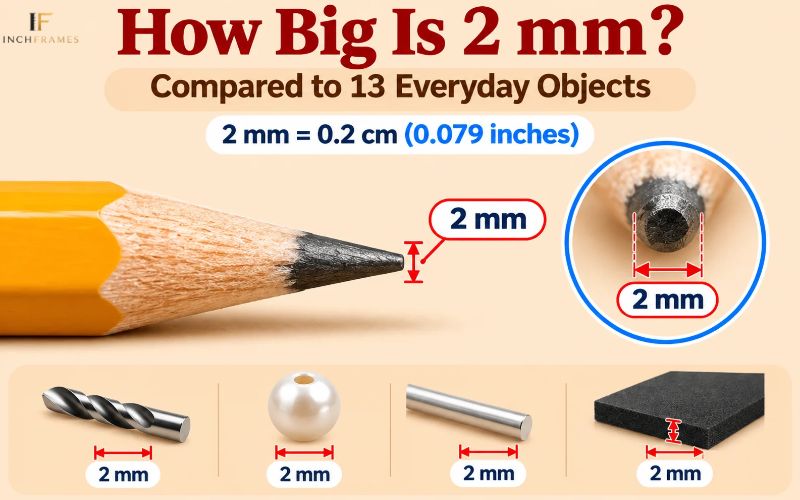
Two millimetres is a very small measurement. It is equal to 0.2 centimetres, 0.079 inches, or about 1/13 of a foot. You might think it is too tiny to notice, but a 2 mm difference can be easy to see when you compare it with familiar objects.
For example, 2 mm is close to the thickness of a US nickel coin. It is also around the combined thickness of three standard plastic cards, depending on their design.
Small measurements like this matter more than you might expect. They can help you judge the size of a screw, check a small gap, choose the right craft material, or understand how thick something really is.
If you don’t have a ruler nearby, don’t worry. Several everyday items can help you picture this tiny length. Let’s look at 13 useful comparisons that make 2 mm easier to understand.
How Big Is 2 mm, Really?
Two millimetres may look almost invisible when you see it on a ruler, but it is still a measurable distance. It is exactly one-fifth of a centimetre and just under eight-hundredths of an inch. That means you would need five 2 mm sections to cover 1 centimetre.
Think about a small gap between two pieces of furniture or the edge of a thin sheet of material. A space of 2 mm is narrow, but you can still notice it when you look closely. You might also come across this measurement when buying small craft supplies, checking a tiny fitting, or choosing a drill bit.
The easiest way to picture it is to compare it with something you already handle every day. A coin, a card, or a small household item can give your eyes a much better idea than a number alone.
2 mm in Real-World Use
A 2 mm measurement can make a real difference in small household and DIY jobs. For example, when fitting a small part into a hole, even a slight difference in size can affect whether the part fits properly. This is why people working with wood, crafts, jewellery, and small repairs often use millimetres.
You may also see 2 mm measurements in product descriptions. A seller might list the thickness of a metal sheet, the width of a small gap, or the diameter of a tiny component. Knowing what 2 mm looks like helps you decide whether that product is suitable for your needs.
It is a small distance, but it is worth checking rather than guessing.
Everyday Things That Are 2 mm in Size
The following 13 objects give you a practical way to picture 2 mm. Some are almost an exact match, while others are close enough to help you estimate the size. Remember that thickness, width, and diameter are different ways of measuring an object.
| Everyday object | Approximate measurement |
|---|---|
| US nickel coin | About 2 mm |
| House key | About 2 mm |
| 2 mm mechanical pencil lead | About 2 mm |
| M2 machine screw | About 2 mm |
| 2 mm Allen key | About 2 mm |
| 2 mm leather craft cord | About 2 mm |
| Two stacked MicroSD cards | About 2 mm |
| 20 sheets of printer paper | About 2 mm |
| 2 mm neoprene sheet | About 2 mm |
| 2 mm craft wire | About 2 mm |
| 2 mm drill bit | About 2 mm |
| 2 mm jewellery bead | About 2 mm |
| US half-dollar coin | About 2 mm |
US Nickel Coin
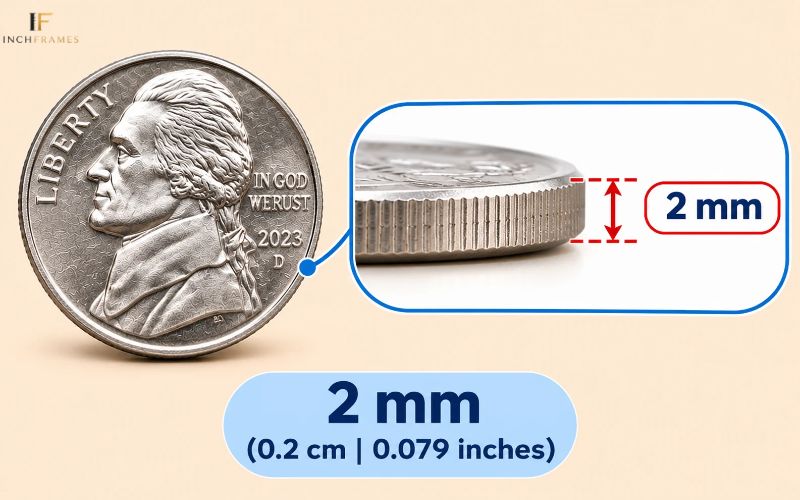
A US nickel is one of the easiest ways to understand 2 mm. Its thickness is approximately 1.95 mm, making it almost the same as the measurement we are trying to picture. The difference is only 0.05 mm, which is extremely small.
Take a nickel from your pocket and look at its side edge. That narrow metal strip gives you a good idea of how thick 2 mm is. You can also place the coin flat on a table and look at its edge from the side.
This is a particularly useful comparison because US coins are made to set dimensions. Just remember that worn or damaged coins may not be perfect measuring tools.
House Key
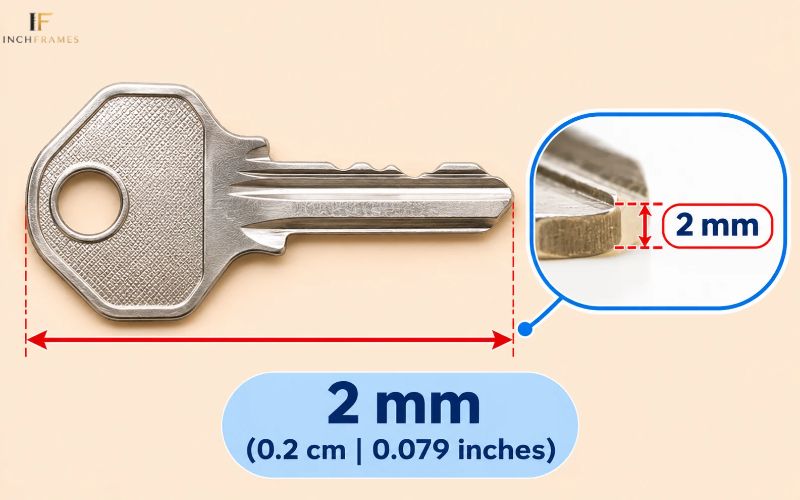
A regular metal house key can be close to 2 mm thick, although the exact thickness depends on its design. Look at the flat metal body of a key rather than its raised cuts or teeth. That flat section can give you a helpful visual reference.
Most people carry a key without thinking about its thickness. You use it to open your front door, lock a cupboard, or secure a gate. Next time you pick one up, look at its edge. It is a handy way to picture a measurement that is smaller than the width of your little fingernail.
Not every key has the same thickness, so use this as a rough comparison rather than an exact measurement.
Related Post: How Long Is 2 Centimeters? Compared to 12 Everyday Objects
Mechanical Pencil Lead
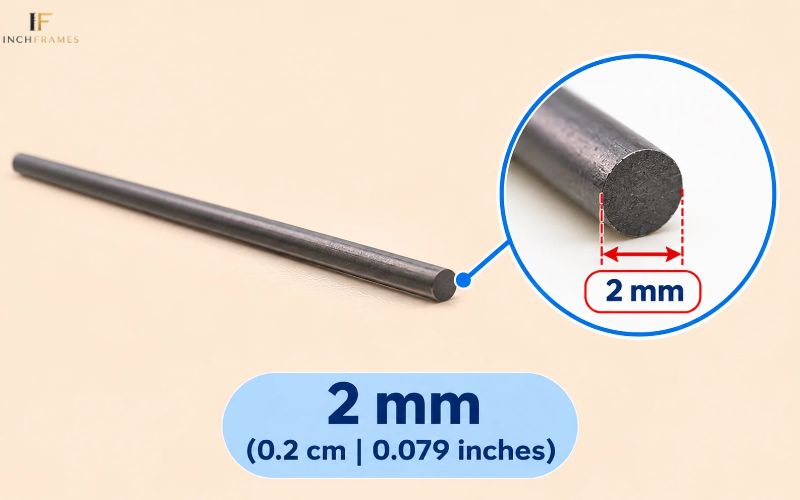
Most ordinary mechanical pencils use thinner lead, but some drafting pencils use 2 mm lead. This type is much thicker than the fine lead you might use for school notes or everyday writing.
The round lead gives you a direct example of a 2 mm diameter. If you place it beside a ruler, you can see how its width matches the distance between the first two millimetre marks.
Artists, designers, and people who enjoy technical drawing often use this type of pencil. The thicker lead can be sharpened to create different points for drawing. If you have one at home, it is a very useful reference because its stated diameter is exactly 2 mm.
M2 Machine Screw
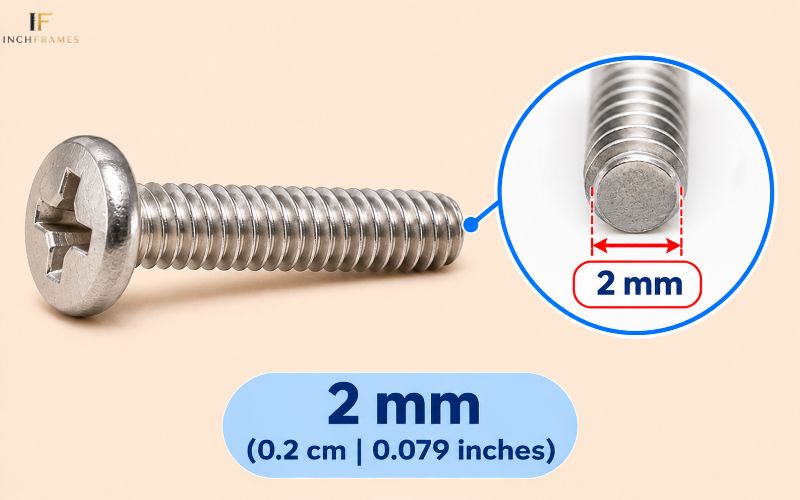
An M2 machine screw has a nominal shaft diameter of 2 mm. The letter M refers to a metric screw, while the number tells you the nominal outside diameter of its threaded section.
These screws are used in small products and equipment where a large fastener would take up too much room. You might find them in electronics, small mechanical parts, hobby projects, and repair kits.
Look at the threaded shaft rather than the screw head. The shaft is the part that provides the 2 mm reference. The threads can make it look slightly different from a smooth cylinder, but the nominal size remains 2 mm. It is a good example of why even a tiny measurement matters when two parts need to fit together.
Allen Key
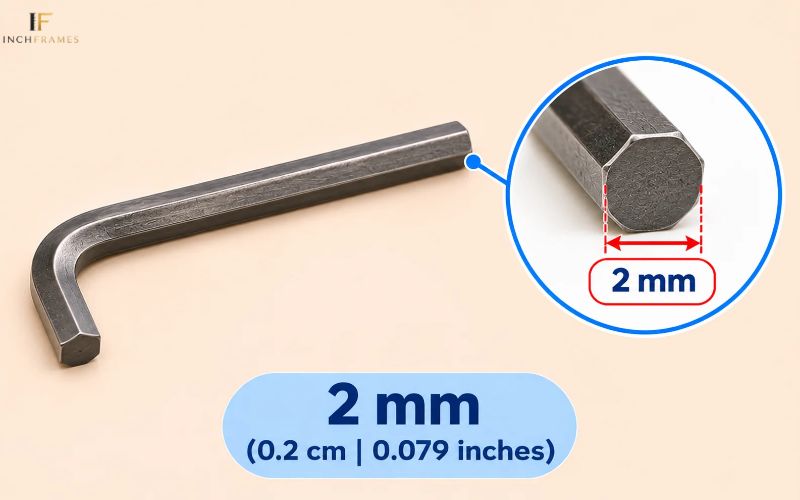
A 2 mm Allen key, also called a hex key, has a width of 2 mm across its flat sides. It is a small L-shaped metal tool used to tighten or loosen screws with hexagonal sockets.
You may have seen these tools included with flat-pack furniture, bicycle accessories, or small household products. They are usually sold in sets with several different sizes.
The shorter end of the tool gives you a useful example of a measurement that is exactly 2 mm across flats. It is not the length of the Allen key that matters here. It is the distance from one flat side to the opposite flat side.
If you have a set at home, check the smallest marked sizes. You may already own this tiny measuring reference without realising it.
Leather Craft Cord
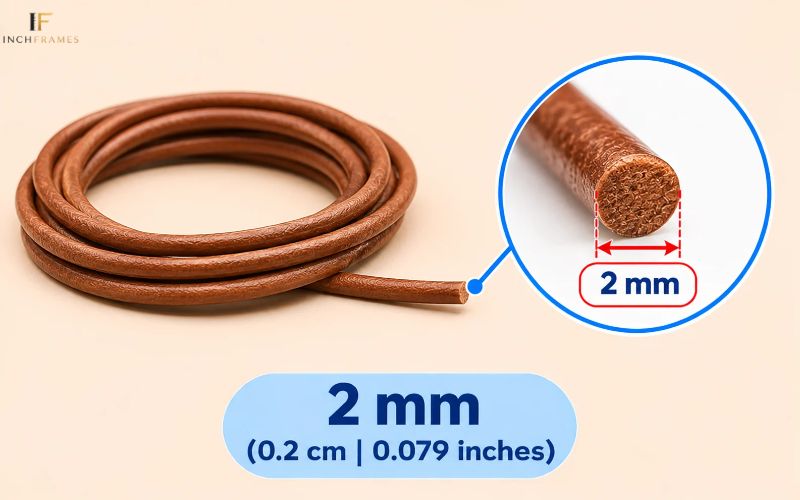
Leather craft cord is sold in several thicknesses, including 2 mm versions. It is commonly used to make bracelets, necklaces, keychains, and other handmade items.
A round 2 mm cord is a useful way to imagine this measurement because you can look at its circular end. That end shows the diameter, which is the distance across the cord from one side to the other through its centre.
The cord is small enough to pass through many jewellery beads and craft findings, but it is still thick enough to hold comfortably between your fingers.
If you enjoy making handmade gifts, you may have come across this size when shopping for craft materials. Check the product label because leather cord thickness can vary.
Related Post: How Long Is 3 Centimeters? Compared to 11 Everyday Objects
Two Stacked MicroSD Cards
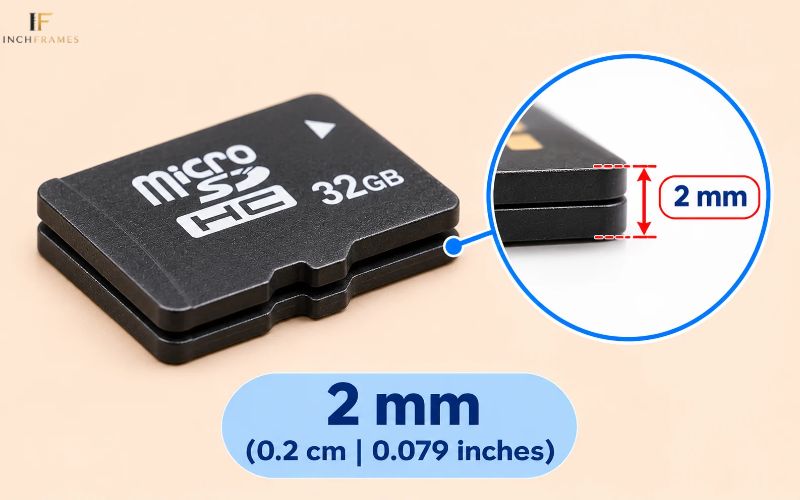
A standard microSD card is approximately 1 mm thick. When you place two compatible cards on top of each other, their combined thickness is around 2 mm.
These tiny memory cards are used in cameras, handheld gaming devices, security cameras, and other electronics. Their small size makes them easy to carry, but it also means they can be difficult to handle if you drop one.
For this comparison, look at the stacked edges rather than the wide surfaces. The combined height gives you a useful picture of 2 mm.
Keep in mind that card thickness can vary slightly by design. Also, handle memory cards carefully so you do not bend or damage their contacts.
20 Sheets of Printer Paper
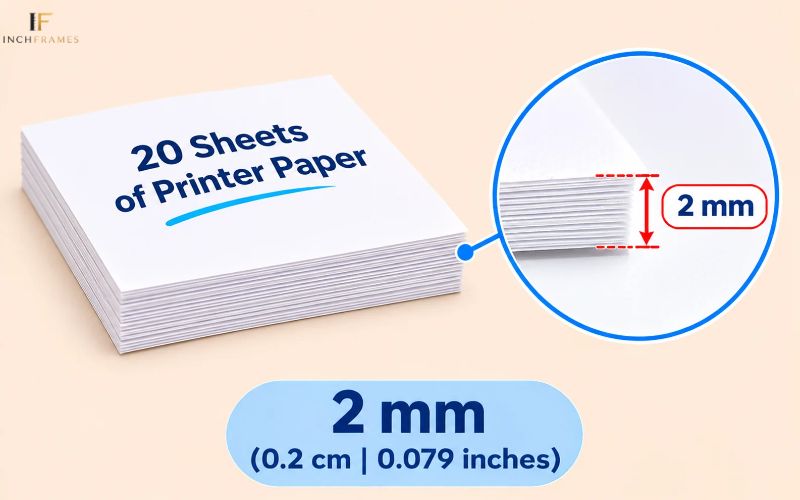
A typical sheet of ordinary printer paper is around 0.1 mm thick, although paper weight and type can change this figure. If you stack 20 sheets, their combined thickness can reach approximately 2 mm.
This is an easy experiment to try at home or in a classroom. Take a small pile of unused paper and look at it from the side. You will notice that each individual sheet is extremely thin, but the layers quickly build up.
Paper is used for schoolwork, printing, drawing, and everyday notes. Most homes and offices have some nearby, so this comparison is easy to test.
For a closer result, use sheets from the same pack. Different paper types may produce a slightly thicker or thinner stack.
Neoprene Sheet
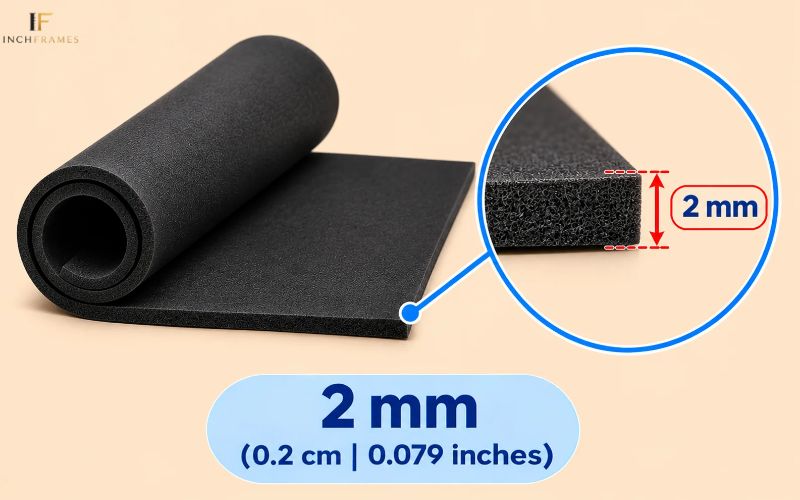
Neoprene is a flexible rubber-like material used in many household and outdoor products. It can be found in protective covers, padding, craft projects, and some sports accessories.
Manufacturers sell neoprene sheets in different thicknesses, including 2 mm versions. The flat edge of one of these sheets gives you a clear example of the measurement.
You can picture it as a thin layer of soft material rather than a solid metal object. When you press it gently between your fingers, you can feel its flexibility.
This comparison is especially helpful if you are buying padding or making a small DIY project. A 2 mm sheet may look thin, but it can still provide a layer between two surfaces.
Craft Wire
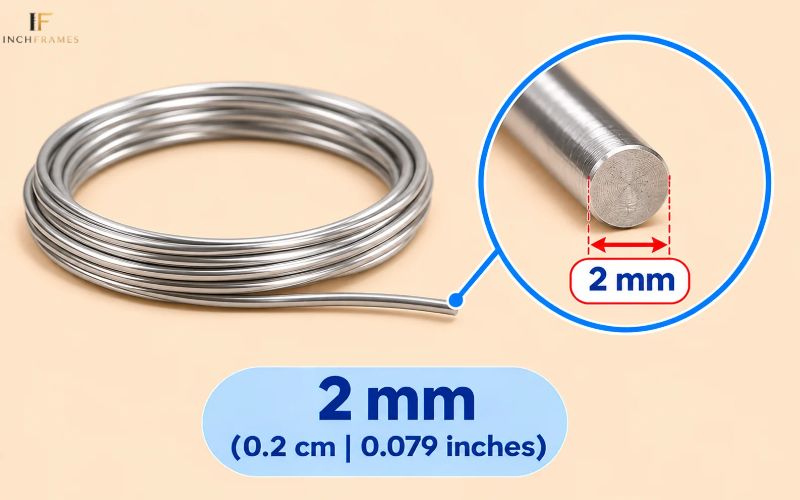
Craft wire is available in several diameters, and 2 mm is one of the sizes you may find when shopping for jewellery-making or decorative projects.
Unlike a flat sheet, wire is round. This means you measure its diameter across the circular section rather than its length. A 2 mm wire is thick enough to hold its shape in many simple craft designs.
People use craft wire to make decorations, jewellery frames, small sculptures, and handmade ornaments. Its thickness affects how easily you can bend it, so choosing the correct size matters.
If you have a 2 mm wire sample, look at its cut end. That tiny circular surface is a simple way to see what a 2 mm diameter looks like.
Related Post: How Long Is 2 Inches? Compared to 13 Everyday Objects
Drill Bit
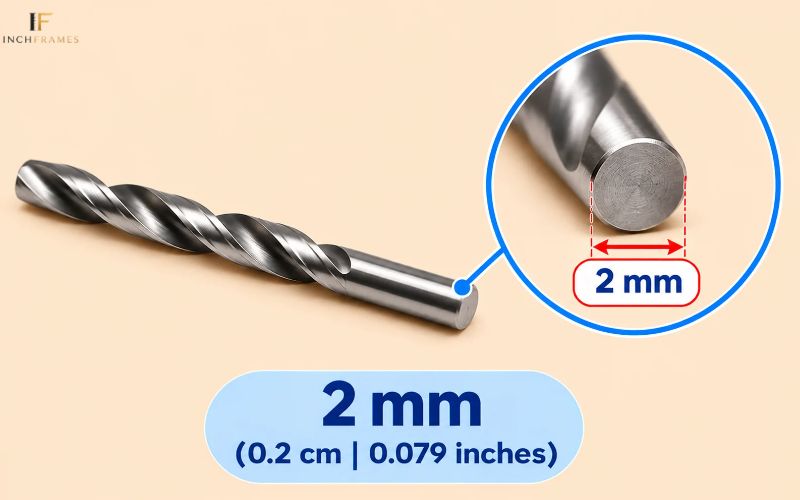
A 2 mm drill bit is designed to make a small hole with a nominal diameter of 2 mm. It is a common type of small drill accessory used for detailed work and small DIY tasks.
Look at the smooth shaft behind the cutting tip. Its diameter is the part that helps you picture the measurement. The cutting grooves may make the end look wider or more complex, but the stated drill size refers to the hole diameter it is designed to make.
Small drill bits are useful for jobs such as making pilot holes in suitable materials or working with small components.
If you own a drill-bit set, check its size markings. A 2 mm bit provides a practical example of how narrow this measurement really is.
Jewellery Bead
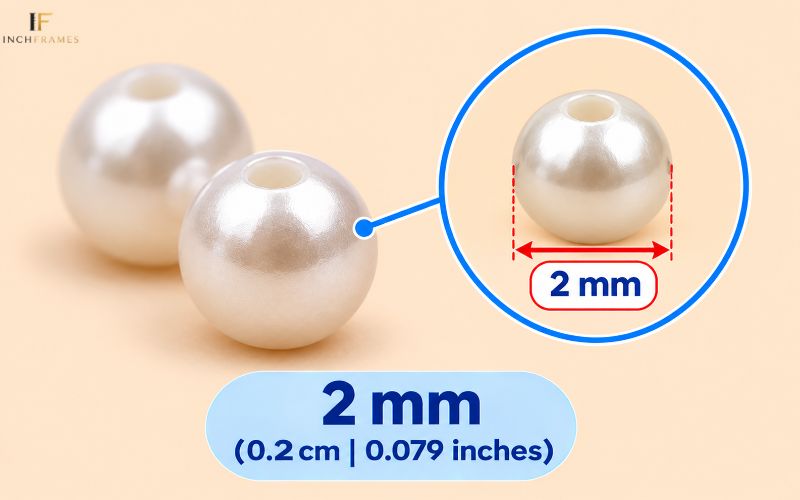
Small jewellery beads are available in many sizes, and some are made with a diameter of 2 mm. These tiny beads are often used as spacers between larger beads or as small decorative details.
A 2 mm bead is easy to underestimate because it looks like a tiny dot when placed on a table. However, if you look closely, you can see its round shape and understand how much space it takes up.
Jewellery makers often use small beads to create detailed patterns in bracelets, necklaces, and other accessories. The hole through the centre is separate from the bead’s outside diameter.
If you are buying beads for a craft project, check whether the seller lists the outside diameter or the hole size. They are not the same measurement.
US Half-Dollar Coin
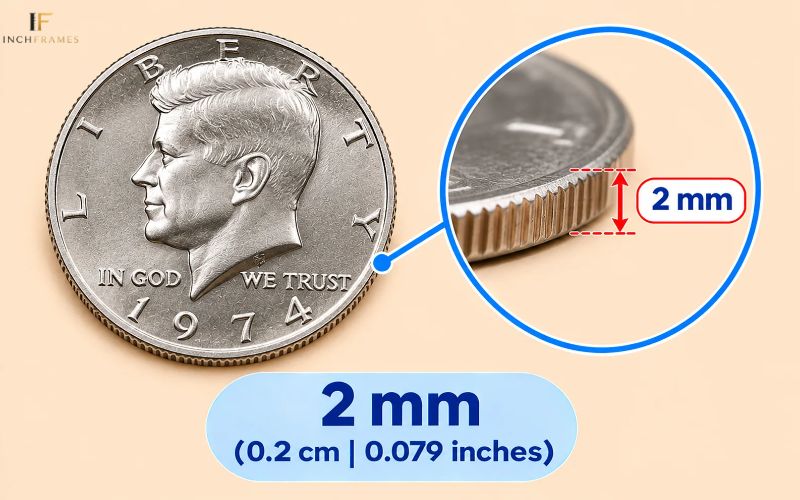
A US half-dollar coin is approximately 2.15 mm thick. This makes it slightly thicker than 2 mm, but it is still a helpful everyday comparison.
The half-dollar is a larger coin than a nickel, and its edge gives you another way to understand this small measurement. Hold it upright and look at the narrow metal surface around its outside.
You may not handle half-dollar coins as often as smaller coins, but they are useful when comparing thicknesses. The difference between 2 mm and 2.15 mm is only 0.15 mm, so the two measurements are very close.
This is a good reminder that an everyday object does not have to match a measurement perfectly to help you picture it.
How to Measure 2 mm Without a Ruler
You can estimate 2 mm even when you do not have a measuring tool nearby. Try these simple methods:
- Use a nickel: If you have a US nickel, its thickness is about 1.95 mm. This is one of the closest everyday comparisons.
- Stack paper: Place around 20 ordinary sheets together. Their combined thickness may be close to 2 mm.
- Check a marked tool: A 2 mm Allen key or drill bit gives you a useful reference if you have a tool set.
- Use a phone magnification feature: Take a close-up picture of a small object beside a known-size reference. This can help you compare shapes, although the camera alone cannot confirm an exact measurement.
These methods are useful for estimating. For a precise measurement, use a ruler with millimetre markings or a suitable measuring tool.
Why Does a Difference of 2 mm Matter?
You might wonder why anyone would worry about such a small distance. The answer is simple: small differences can affect how things fit and work.
Imagine installing a screw into a small hole. If the hole is too narrow, the screw may not fit. If it is too wide, the connection may become loose. The same idea applies when choosing craft materials, fitting small parts, or buying replacement components.
Even a change from 2 mm to 5 mm can make a noticeable difference in a small project. That is why product descriptions often include measurements in millimetres.
When shopping online, check the listed size instead of relying only on product photographs. Pictures can make tiny items appear much larger than they really are.
Related Post: How Long Is 9 Inches? Compared to 12 Everyday Objects
Frequently Asked Questions
How big is 2 mm compared to an inch?
Two millimetres is approximately 0.079 inches. It is slightly smaller than one-tenth of an inch, so it is a very small distance.
Is 2 mm bigger than 1 cm?
No. One centimetre equals 10 mm, so 2 mm is only one-fifth of a centimetre. You would need five 2 mm sections to make 1 cm.
What does 2 mm look like on a ruler?
On a metric ruler, 2 mm is the second small marking after the zero line. It is a very short distance, even when viewed on a ruler with clear markings.
Is 2 mm the same as the thickness of a nickel?
Almost exactly. A US nickel is approximately 1.95 mm thick, which is just 0.05 mm less than 2 mm. Online Metals+1
How many sheets of paper make 2 mm?
Around 20 sheets of ordinary printer paper can make a stack approximately 2 mm thick. The actual number may change depending on the paper’s thickness.
Can I measure 2 mm with my fingers?
You can try to estimate it, but your fingers are not accurate enough for such a small measurement. A coin or a millimetre-marked ruler will give you a much better reference.
Is 2 mm considered a small measurement?
Yes. It is a very small measurement, equal to 0.2 cm. However, it can still make a noticeable difference when working with small tools, screws, jewellery, and other detailed items.
What is the easiest way to visualize 2 mm?
A US nickel is one of the easiest references because it is approximately 1.95 mm thick. A 2 mm mechanical pencil lead or a 2 mm Allen key can also help you picture the size.
Final Remarks
Two millimetres may seem like an almost invisible distance, but everyday objects make it much easier to understand. A US nickel, a small machine screw, a drill bit, and a stack of printer paper all provide useful ways to picture this measurement.
Remember that 2 mm equals 0.2 cm and approximately 0.079 inches. These conversions are worth keeping in mind when you shop for small parts or work on a DIY project.
My favourite quick comparison is the nickel because you can hold it in your hand and inspect its edge. When you need an exact result, though, always reach for a proper ruler or measuring tool.
