
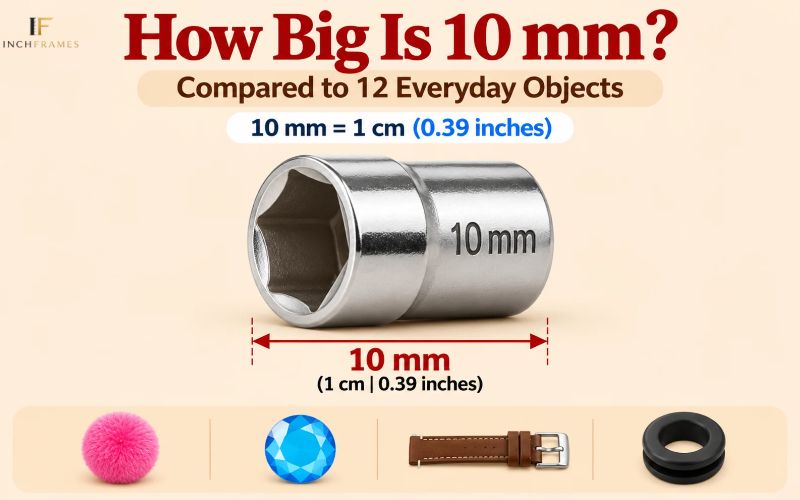
10 millimetres (mm) is a small measurement, but it is bigger than you might think. It equals 1 centimetre (cm), 0.39 inches, or just under half an inch. To picture this size, imagine the width of a small shirt button or a craft bead sitting in your hand.
You probably come across 10 mm measurements more often than you realise. They appear in craft supplies, small tools, household fittings, and many other everyday items. However, looking at a number on a measuring tape does not always help you understand how large something really is.
The easiest way to picture 10 mm is to compare it with familiar objects. Some items are made in this exact size, while others have dimensions that come very close.
In this guide, you’ll discover 12 everyday examples that make 10 mm easier to picture. You’ll also learn simple ways to estimate this measurement without carrying a ruler.
How Long Is 10 mm, Really?
Ten millimetres is the same as one centimetre. If you look at the centimetre marks on a metric ruler, the distance between 0 and 1 is exactly 10 mm. It is a short distance, but it is large enough to see clearly without needing a magnifying glass.
In inches, 10 mm measures approximately 0.39 inches. That means it is a little shorter than half an inch. If you have a gap of this size between two small parts, you can usually see the difference with your eyes.
You might find this measurement when checking the opening of a small fitting, choosing a craft supply, or looking at the thickness of a household part. For comparison, 20 mm equals 2 centimetres, which is twice the length of 10 mm. It is also useful to recognise these measurements when reading metric sizes on product packaging. Once you understand how one centimetre looks, many small measurements become much easier to judge.
Where Is 10 mm Used in Real Life?
A 10 mm measurement is common in small hardware and home improvement work. For example, a 10 mm socket is made to fit certain nuts and bolts. If you are putting together furniture, fixing a bicycle, or working on a small repair, you may see this size printed on a tool.
It also appears in craft and sewing supplies. Beads, buttons, and other small decorative pieces are often sold in centimetre-based sizes. Knowing what 10 mm looks like can help you choose the right item before buying it.
One useful thing to remember is that 10 mm does not always describe the same part of an object. It may refer to its width, diameter, height, or opening. Always check which dimension a product listing is showing.
Everyday Things That Are 10 mm Long or Wide
The following 12 objects can help you picture a measurement of 10 mm. Some are commonly manufactured at exactly 10 mm, while others are close examples. Their measurements may change slightly depending on the product.
| Everyday object | Approximate measurement |
|---|---|
| Small craft bead | 10 mm |
| Sewing button | 10 mm |
| 10 mm hex nut | 10 mm |
| 10 mm socket | 10 mm |
| Crochet hook | 10 mm |
| Wooden craft dowel | 10 mm |
| Tile spacer | 10 mm |
| Small pom-pom | 10 mm |
| Watch strap | 10 mm |
| Rubber grommet | 10 mm |
| Craft foam sheet | 10 mm |
| Small decorative cabochon | 10 mm |
Small Craft Bead
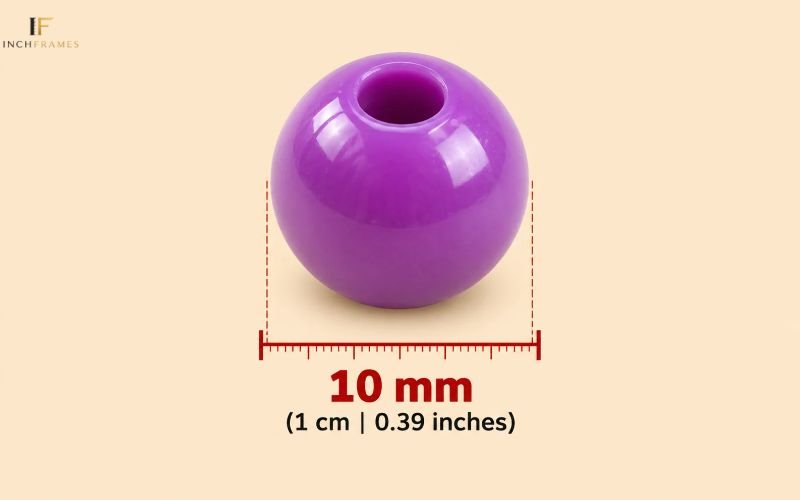
A small 10 mm craft bead is one of the easiest ways to understand this measurement. Its diameter is exactly one centimetre when you choose a bead made to that size. You can hold it between your thumb and index finger and get a clear idea of how much space 10 mm takes up.
These beads are often used for bracelets, necklaces, keychains, and other handmade decorations. They come in many materials, including glass, plastic, and wood.
What makes this example useful is its simple shape. You do not have to think about length or thickness because you can look straight across its widest part. A bead marked 10 mm gives you a practical reference whenever you need to picture one centimetre.
Small Sewing Button
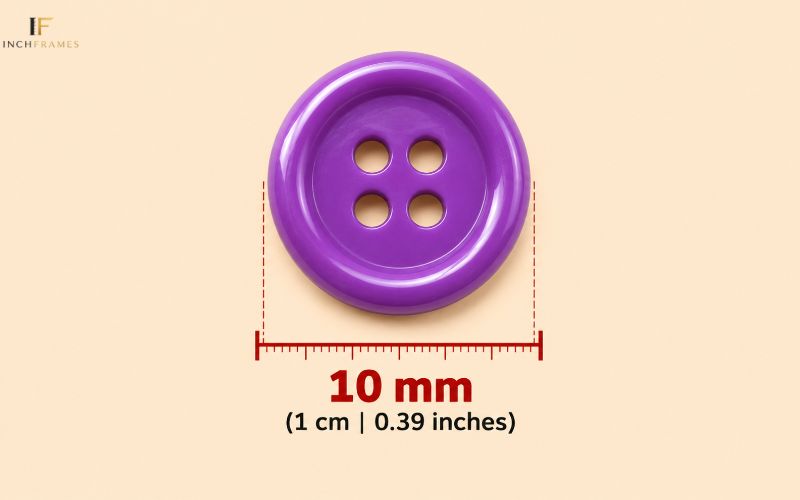
A small sewing button can also give you a good idea of 10 mm. Many shirts and children’s clothing use small buttons around this size, although button measurements vary by garment and style. A button with a 10 mm diameter measures exactly one centimetre across its face.
Look at a shirt or cardigan with several buttons. You may notice that the smaller buttons are easy to hold between two fingertips. Their size is also useful when sewing because the button must fit through the matching buttonhole.
This is a helpful household comparison because most people have seen or handled buttons before. If you have one marked 10 mm, place it beside a ruler and remember its appearance. It can make future size estimates much easier.
Related Post: How Big Is 9 mm? Compared to 12 Everyday Objects
Hex Nut
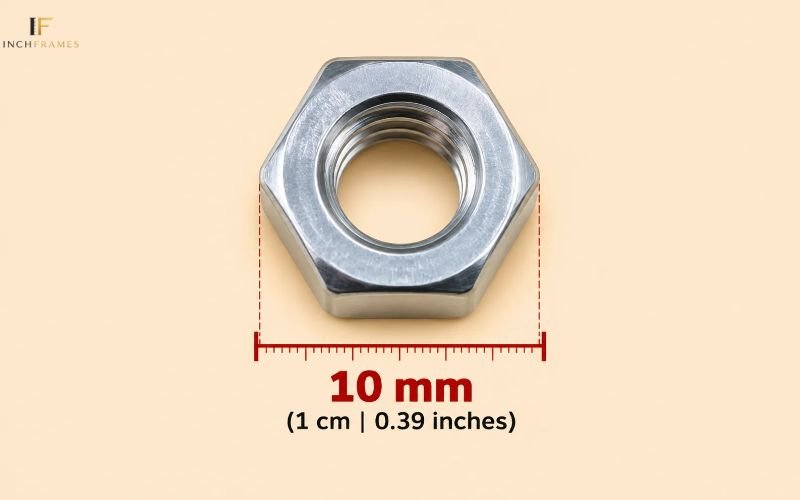
A 10 mm hex nut is a practical example from the world of tools and hardware. Its 10 mm measurement refers to the distance across two opposite flat sides, not the full width from one corner to another. This is the measurement used when selecting a matching spanner or wrench.
You may find these nuts in furniture fittings, bicycle parts, machinery, and home repair kits. Their six-sided shape makes them easy to recognise.
If you place the nut beside a metric ruler, the distance across its flat sides will match the 10 mm mark. This example is especially useful because the size is printed on many matching tools. Just remember that the nut’s outside corner-to-corner measurement is larger than 10 mm.
Socket
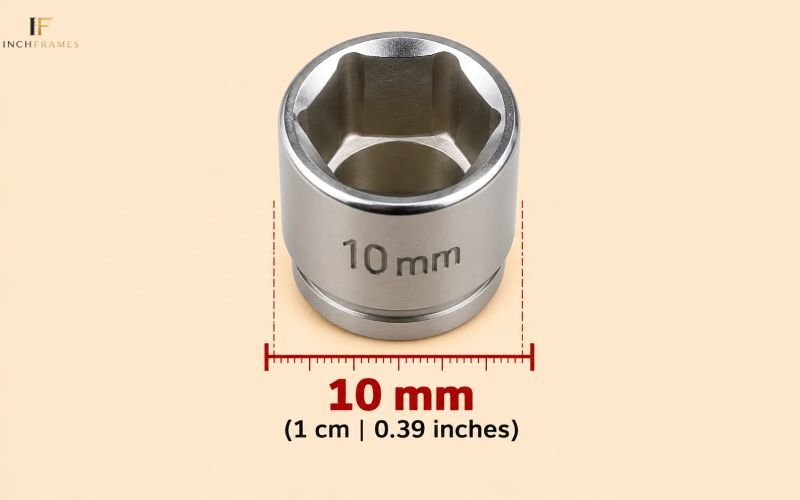
A 10 mm socket is another familiar tool that helps you understand this measurement. It is designed to fit nuts and bolts with a 10 mm across-flats size. The opening inside the socket is shaped to grip the six flat sides of the fastener.
You might see this tool in a car repair kit, a household toolbox, or a bicycle maintenance set. Many socket sets include different sizes, so the numbers are often printed or stamped on the tools.
A 10 mm socket is a useful reference because it is made for a specific measurement. Hold it in your hand and look at its opening. Although the socket itself is longer than 10 mm, the working opening gives you a clear example of the size.
Crochet Hook
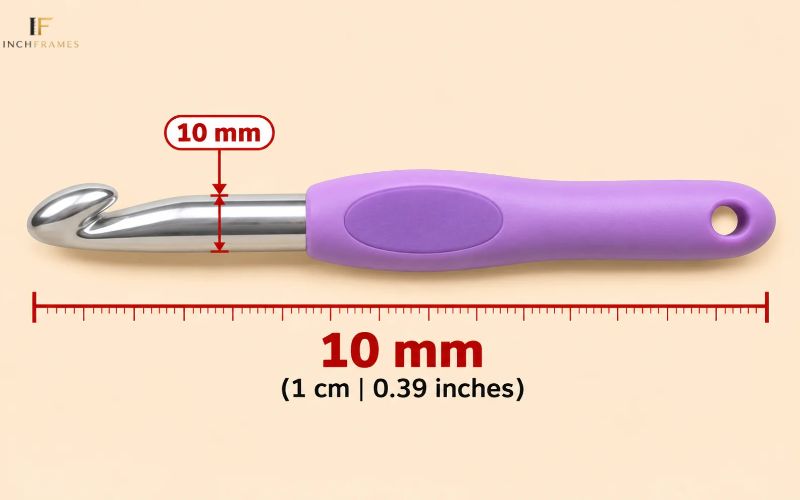
If you enjoy knitting or crochet, you may already have a 10 mm crochet hook at home. The size usually refers to the diameter of its shaft, which is the smooth section that holds the yarn. This part measures approximately one centimetre across.
A crochet hook of this size is noticeably thicker than the fine hooks used for delicate thread projects. It is often used with bulky yarn to make blankets, scarves, baskets, and other larger projects.
Look at the shaft from the side and imagine measuring straight across it. That distance is 10 mm. This example is particularly useful because you can find crochet hooks in clearly marked sizes. It also shows how one small measurement can affect the kind of material or project you work with.
Related Post: How Big Is 8 mm? Compared to 11 Everyday Objects
Wooden Craft Dowel
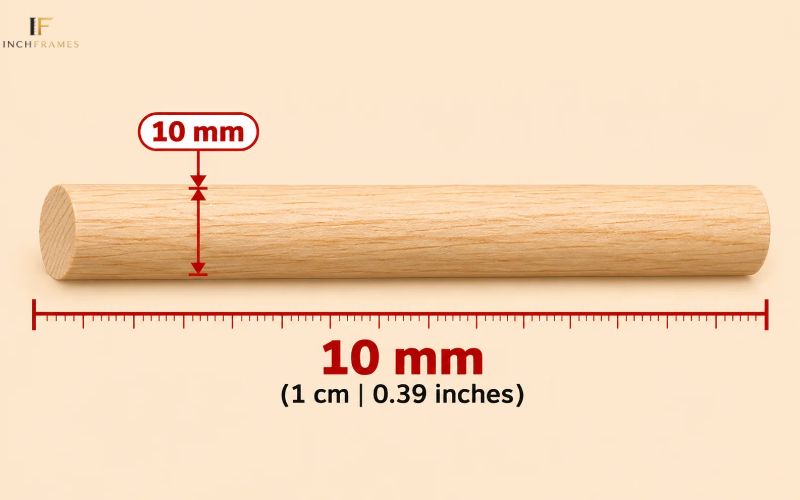
A wooden craft dowel with a 10 mm diameter is another useful comparison. A dowel is a straight, round piece of wood often used in school projects, model making, furniture repairs, and simple DIY work.
Imagine holding a short wooden stick between your fingers. Its circular end would measure one centimetre across if it were a 10 mm dowel. The stick may be several centimetres or even much longer, but its thickness stays the same along its length.
You can find wooden dowels in craft shops and hardware stores. They are often sold in different thicknesses, making them useful for building small structures or supporting handmade projects. Look at the round end rather than the length to understand the 10 mm measurement.
Tile Spacer
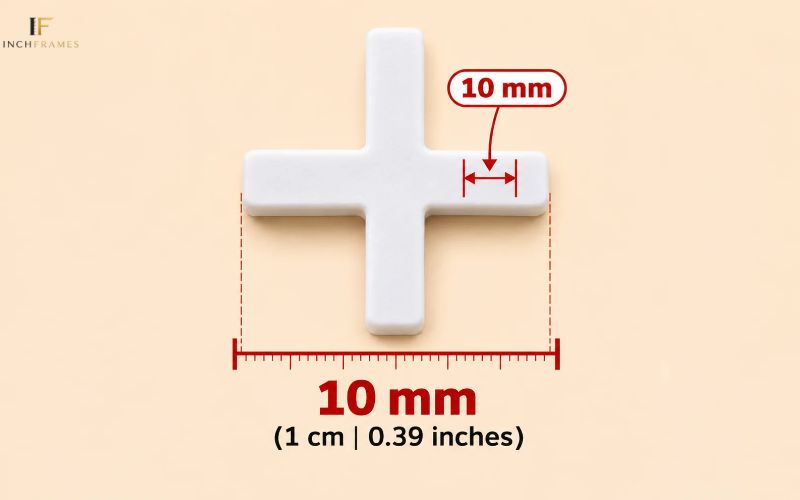
A 10 mm tile spacer is a small fitting used during some tiling projects. It helps maintain a set gap between tiles so the spaces remain even across a floor or wall. Certain spacer designs are made with a 10 mm width or spacing dimension.
You might see these plastic pieces in a DIY shop or inside a tile installation kit. They are usually small and lightweight, so they are easy to carry in a pocket or toolbox.
This example is useful because it shows how a one-centimetre measurement can affect the appearance of a larger surface. A small spacer can help create consistent gaps across many tiles. However, check the packaging carefully because different spacer designs use different measurements.
Small Craft Pom-Pom
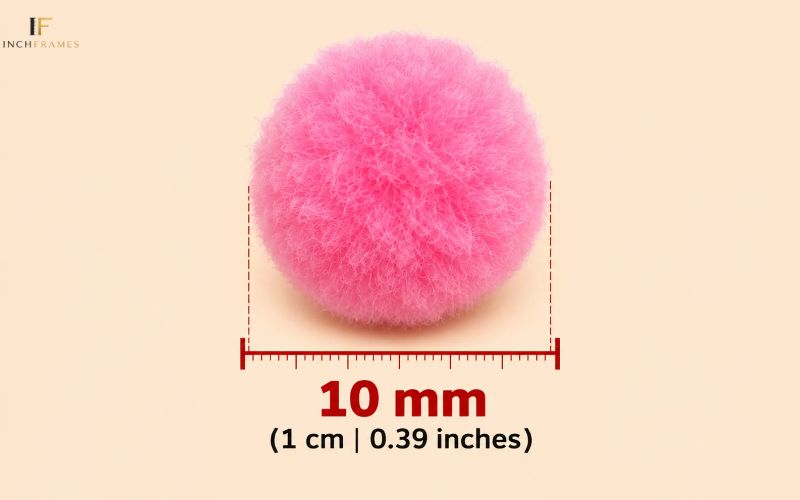
A small craft pom-pom measuring around 10 mm in diameter is another simple way to picture one centimetre. These soft, round decorations are often used in children’s art projects, handmade cards, school activities, and small decorative designs.
Pick one up and hold it between your fingertips. You will notice that it is small enough to fit comfortably without covering much of your finger. Its rounded shape makes it easy to compare with a centimetre mark on a ruler.
Craft pom-poms are sold in several sizes, so not every small one will measure 10 mm. Look for packaging that specifically lists a 1 cm or 10 mm diameter. This gives you a more dependable reference instead of judging the size by appearance alone.
Related Post: How Big Is 7 mm? Compared to 10 Everyday Objects
Narrow Watch Strap
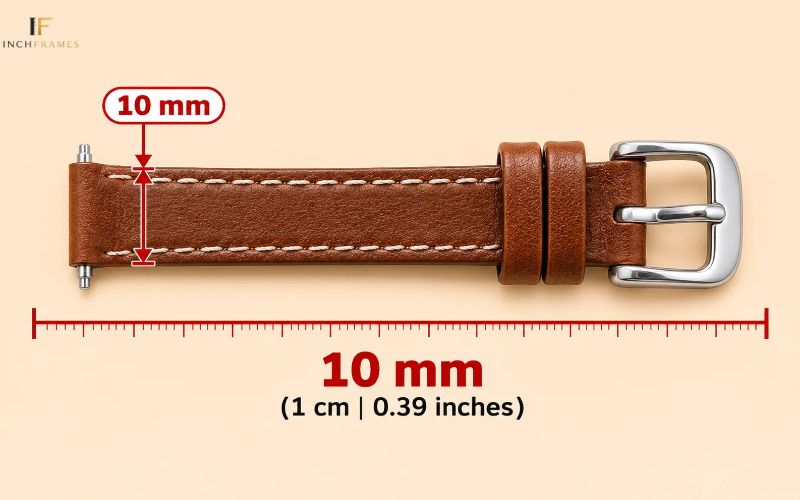
Some narrow watch straps are made with a width of 10 mm. This measurement is taken across the strap, not along its length. You can find narrow straps on certain small watches, children’s watches, and delicate designs.
Look at the part of the strap that connects to the watch case. If it measures 10 mm across, that is exactly one centimetre. The strap may become wider or narrower farther along, depending on its design.
This example is useful when shopping for a replacement watch band. A strap that looks almost the right size may still fail to fit properly if the width is different. Measuring the connection point before buying can save you from choosing the wrong replacement.
Rubber Grommet
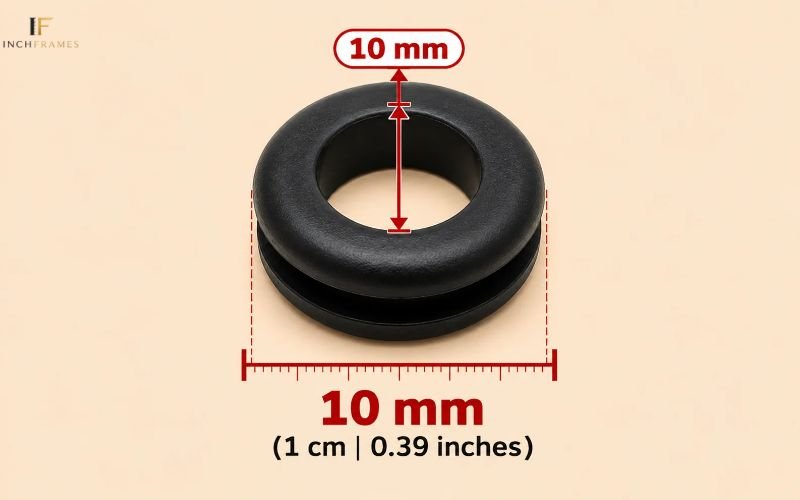
A small rubber grommet can help you understand 10 mm by looking at its inner opening. Grommets are round rubber or plastic fittings used to protect wires and cables where they pass through a hole in a panel or surface.
Some models are designed with a 10 mm inner diameter. This means the open space in the middle measures one centimetre across. The outside diameter will be larger because the rubber ring adds material around the opening.
You may find these parts in electrical projects, furniture, workshops, or car repairs. If you look closely at one, you can see how a small measurement is used to make sure a cable or fitting passes through the right-sized opening.
Related Post: How Big Is 5 mm? Compared to 13 Everyday Objects
Thick Craft Foam Sheet
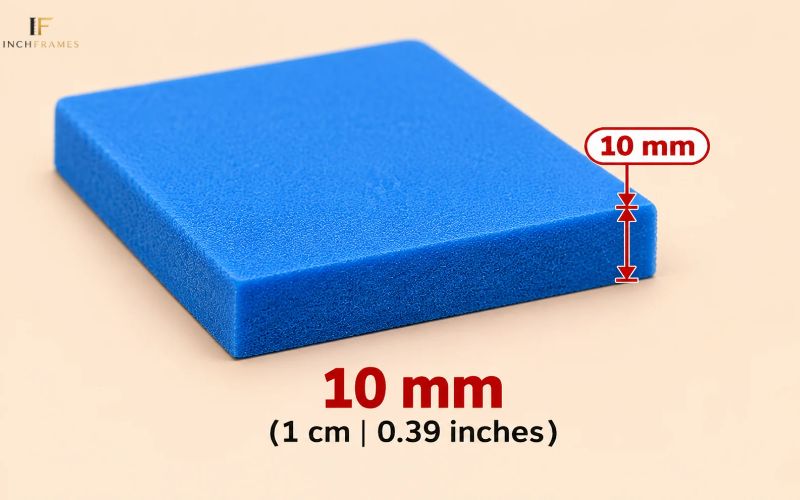
Some craft foam sheets are available in thicknesses of 10 mm. This is much thicker than the thin foam sheets often used for school crafts. A 10 mm piece has a full centimetre of material between its two flat surfaces.
You might use thicker foam for handmade decorations, costume parts, models, or small protective projects. When you look at its cut edge, the thickness becomes easy to see.
This is a slightly different comparison from a button or bead because it shows 10 mm as a depth rather than a width. Place the foam beside a ruler and look at the edge. You will get a clear idea of how much space one centimetre takes up when measured from front to back.
Small Decorative Cabochon
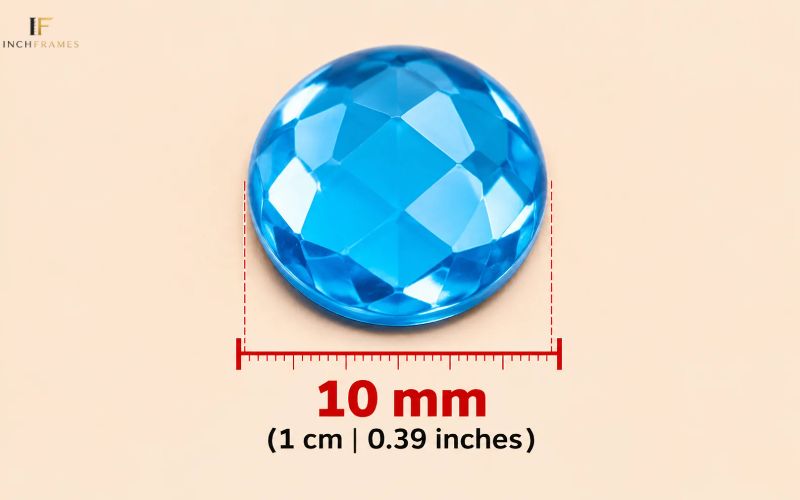
A 10 mm decorative cabochon is a small, smooth piece used in jewellery and craft projects. These pieces are often round or oval, with a flat back and a curved top. A 10 mm round cabochon measures one centimetre across its widest part.
You may see them used in rings, pendants, hair accessories, and handmade decorations. They come in different materials, such as glass, resin, and stone.
Their smooth surface makes them easy to compare with a ruler. Hold one between your fingers and look at the distance from one edge to the opposite edge. It is a good example of a small, clearly defined measurement. When shopping, check whether the listed size refers to the width, height, or diameter.
How to Measure 10 mm Without a Ruler
You do not always need a ruler to get a rough idea of 10 mm. Here are four simple ways to estimate one centimetre:
- Use a centimetre mark: If you have a measuring tape with metric markings, the distance from 0 to 1 cm is exactly 10 mm.
- Use a measuring tape: Most metric tapes show centimetres and smaller millimetre marks. Find the first centimetre section to see the size.
- Fold a paper strip: Mark a small section of paper that measures one centimetre using a known reference, then keep it as a quick guide.
- Use a familiar one-centimetre item: A verified 10 mm button or bead can serve as a reference when checking another small object.
These methods are useful for quick estimates, but use a proper ruler when accuracy matters.
How Does 10 mm Compare With Other Measurements?
Understanding nearby measurements can make 10 mm easier to remember. For example, 5 mm is half of 10 mm, so it is noticeably shorter. A 15 mm measurement is one and a half centimetres, while 20 mm equals 2 cm.
You can also compare it with inches. One inch measures 25.4 mm, which means 10 mm is less than half an inch. If you are looking at a product listed in inches, a measurement of 0.5 inches is slightly larger than 10 mm.
These small differences matter when choosing replacement parts, craft supplies, or fittings. A piece that is only a few millimetres too large may not fit where you need it.
Frequently Asked Questions
How big is 10 mm in inches?
10 mm is approximately 0.39 inches. It is a little shorter than 0.5 inches, which is just under half an inch.
Is 10 mm the same as 1 cm?
Yes. One centimetre is exactly 10 millimetres. Both measurements describe the same length.
How big is 10 mm compared to a finger?
10 mm is about one centimetre across. It is usually much narrower than the full width of an adult finger, although finger sizes vary from person to person.
Is 10 mm bigger than half an inch?
No. Half an inch equals 12.7 mm, so 10 mm is 2.7 mm shorter than half an inch.
How many millimetres are in 2 cm?
There are 20 millimetres in 2 centimetres. Each centimetre contains 10 millimetres.
Can I measure 10 mm with my fingers?
You can make a rough estimate, but your finger width is not a fixed measurement. For a more reliable result, use a metric ruler or a verified one-centimetre reference.
What common object is 10 mm wide?
A small craft bead, a 10 mm sewing button, and some narrow watch straps can measure around 10 mm. Check the product size because not every example will have the same dimensions.
Is 10 mm considered a small measurement?
Yes. Ten millimetres is only one centimetre, so it is a relatively small measurement. However, it can make a noticeable difference when working with small parts, fittings, and craft materials.
Final Remarks
10 mm may seem like a tiny measurement, but it becomes much easier to picture when you compare it with familiar objects. A small craft bead, a sewing button, or the opening of a 10 mm socket can all help you understand how much space one centimetre takes up.
The easiest fact to remember is that 10 mm equals 1 cm or approximately 0.39 inches. Keep this conversion in mind when shopping, making repairs, or working on a craft project.
One simple tip: whenever you see a measurement in millimetres, divide it by 10 to convert it into centimetres. It is a quick way to make small metric measurements easier to understand.
