
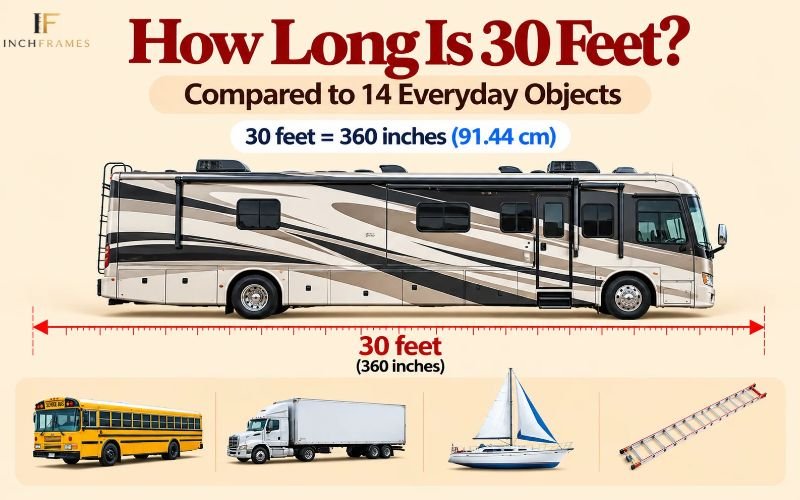
30 feet is equal to 360 inches, 10 yards, or about 9.14 meters. To picture it, imagine laying ten 3-foot rulers end to end. That gives you exactly 30 feet.
Thirty feet is a fairly long distance for something you see or use every day. It is about the length of a large recreational vehicle, close to the length of some fire trucks, and roughly the combined length of two average cars parked bumper to bumper. It can also span a good-sized room, driveway, or backyard.
If you do not have a tape measure nearby, everyday objects can make this measurement much easier to understand. Below, we will look at 14 useful comparisons and explain how each one helps you picture 30 feet in real life.
Why 30 Feet Is a Useful Measurement
Thirty feet shows up in more places than you might expect. It is a practical size for things such as extension cords, hoses, ladders, boats, recreational vehicles, and some larger work vehicles. A 30-foot length can also describe the distance across an outdoor space, driveway, or small section of a yard.
For perspective, 30 feet equals 10 yards. That makes it easy to picture if you are familiar with a football field, where the field is marked in 10-yard sections. It is also 360 inches, so a standard 12-inch ruler would need to be placed end to end 30 times.
Another useful comparison is the meter. Since 30 feet is about 9.14 meters, it is a little longer than nine 1-meter sticks placed in a straight line. That difference is small enough to help with estimating, but large enough that you should not treat 9 meters and 30 feet as exactly the same measurement.
How to Picture 30 Feet Without a Tape Measure
You can get a good rough idea of 30 feet by using familiar things around you:
Count your steps
A normal walking step is often around 2 to 3 feet. About 12 to 15 steps can put you near 30 feet, depending on your stride.
Use two cars
Many passenger cars are about 14 to 16 feet long. Two cars parked bumper to bumper would be roughly 28 to 32 feet, making them a great visual reference.
Think of five doors:
A standard interior door is about 6 feet 8 inches tall. Five doors placed end to end would be about 33 feet 4 inches, slightly longer than 30 feet.
Picture 10 yards
Since 3 feet make 1 yard, 30 feet is exactly 10 yards. If you can picture a 10-yard stretch on a sports field, you have a good sense of the distance.
14 Everyday Objects That Are 30 Feet Long
The objects below are either around 30 feet long or can be arranged to create a very close 30-foot reference. Exact sizes can vary by model, brand, or design, so use them as visual guides rather than precision measuring tools.
| Everyday Object | Approx. Size | Everyday Context |
|---|---|---|
| Large dining tables lined up | 30 Feet | Events & dining |
| School bus | 30 Feet | Schools & transport |
| 30-foot ladder | 30 Feet | Building work |
| 30-foot RV | 30 Feet | Camping & travel |
| Large moving truck | 30 Feet | Moving house |
| Fire truck | 30 Feet | Emergency services |
| 30-foot sailboat | 30 Feet | Boating |
| Large pontoon boat | 30 Feet | Recreation |
| Two average cars end to end | 30 Feet | Roads & parking |
| Five interior doors end to end | 30 Feet | Home reference |
| Three large sofas end to end | 30 Feet | Furniture |
| Row of 10 shopping carts | 30 Feet | Shopping |
| Two parking spaces end to end | 30 Feet | Parking lots |
| Large recreational boat trailer | 30 Feet | Transport & boating |
Large Dining Tables Lined Up
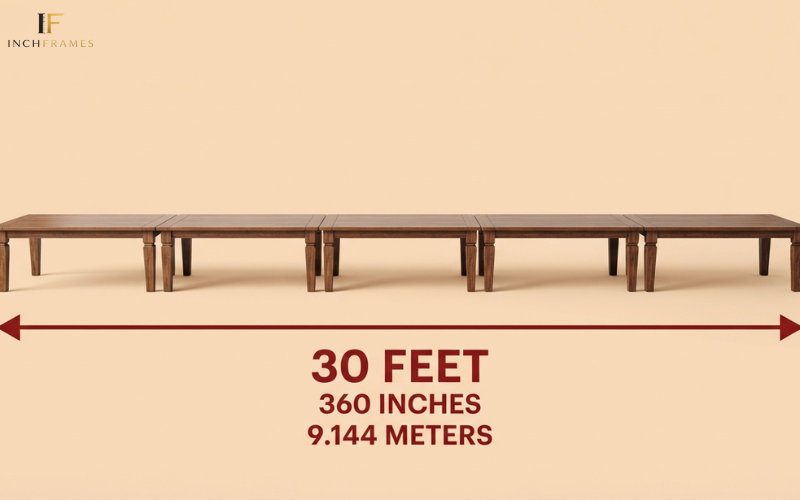
A single dining table is nowhere near 30 feet long, but several large dining tables placed end to end can create a useful visual reference for this distance. For example, three large tables measuring around 8 to 10 feet each could stretch close to 30 feet. This is especially easy to picture in a banquet hall, wedding venue, or large community room.
Imagine walking along the length of the tables from the first table’s edge to the last. You would be covering roughly 30 feet, or 10 yards. This comparison works well because tables have a familiar rectangular shape and a clear beginning and end. The exact total depends on the table sizes, so this is best used as a visual estimate rather than an exact measurement.
A School Bus
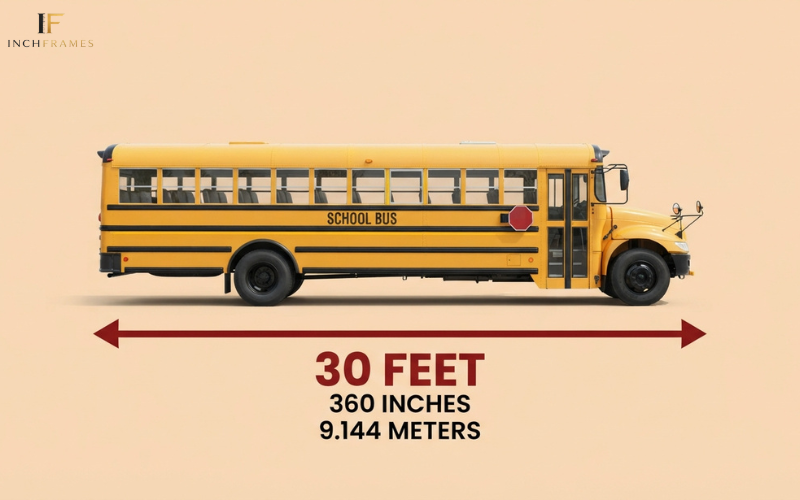
A full-size school bus can give you a surprisingly good idea of how long 30 feet feels. School buses vary in size, and some full-size models are around 30 to 40 feet long. A shorter full-size bus can therefore be close to the 30-foot mark.
Picture one parked along a school curb. Walking from the front bumper to the rear gives you a strong sense of the distance. It is much longer than an ordinary car, yet still a familiar object that many people have seen up close.
Because bus sizes differ, do not assume every school bus is exactly 30 feet. Instead, think of a large school bus as being in the same general size range. That makes it a useful real-world comparison when you want to visualize a distance of about 9.14 meters.
Related Post: How Long Is 20 Feet? Compared to 15 Everyday Objects
Foot Ladder
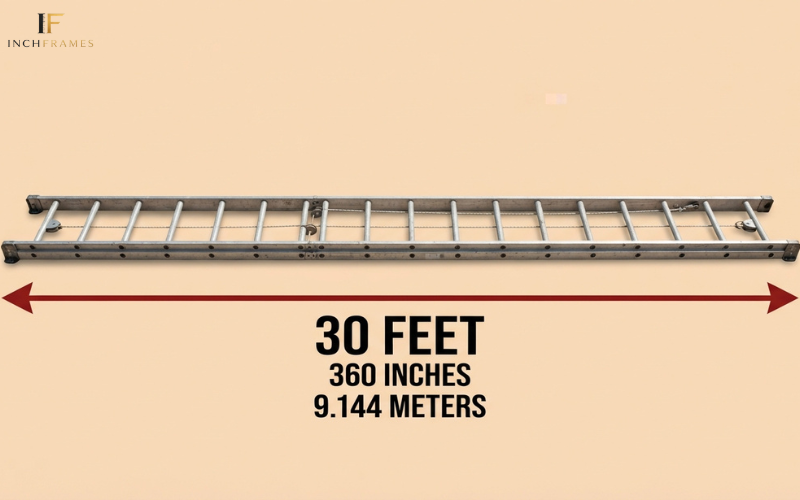
A 30-foot ladder is a direct way to picture this measurement. Unlike an object that only happens to be close to 30 feet, a ladder can be specifically sold in a 30-foot length.
Imagine laying the ladder flat on the ground with its full length extended. From the bottom to the top, it would cover 30 feet. That is the same as 360 inches or 9.144 meters.
This comparison is especially useful because a ladder is long and narrow, making its length easy to see. If you have ever stood near a tall extension ladder, you can probably picture how much space it takes up. Just remember that a ladder leaning against a building may reach 30 feet vertically while taking up less than 30 feet of horizontal ground distance.
A RV
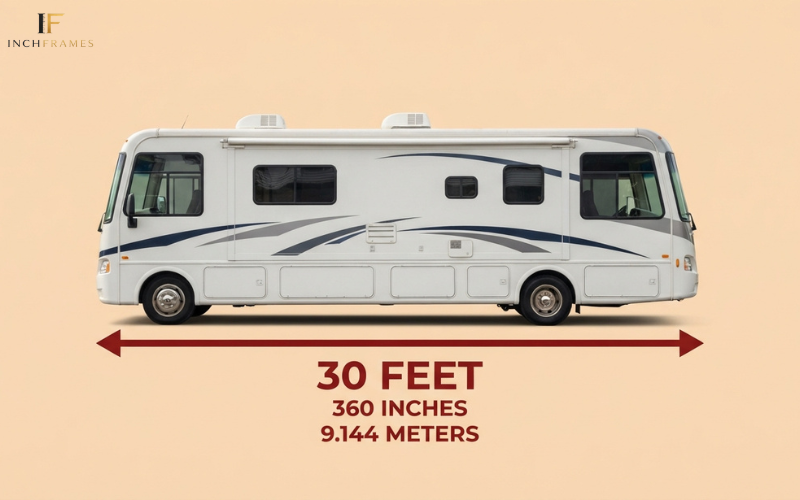
A recreational vehicle around 30 feet long is one of the easiest large-object comparisons to imagine. When parked, it can occupy a substantial part of a driveway or campsite.
Imagine standing at the front bumper and looking all the way toward the back. The vehicle stretches roughly 30 feet from end to end. That is about the same as 10 yards.
RV lengths vary widely, so not every motorhome will match this measurement. Some are much shorter, while larger models can exceed 30 feet. A 30-foot RV, however, gives you a very practical picture of the scale. If you have seen a large motorhome at a campground, you already have a good idea of how much space 30 feet can cover.
A Large Moving Truck
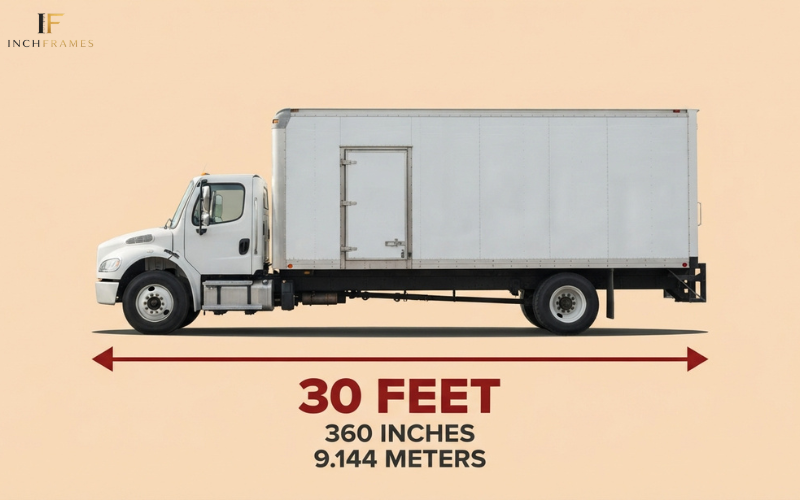
A large moving truck can come surprisingly close to 30 feet in length. Depending on the truck size, the vehicle may be around 26 feet or longer. Some larger moving trucks approach the 30-foot range.
Think about one parked outside a house on moving day. Its cargo box alone is huge, and the cab adds several more feet. From the front of the truck to the back, the total distance can give you a good mental picture of 30 feet.
This comparison is useful because moving trucks are common enough to recognize. If you have watched one parked beside a house, you know they are much longer than a typical car. Since truck sizes vary, use this as an approximate reference rather than assuming every moving truck is exactly 30 feet.
A Fire Truck
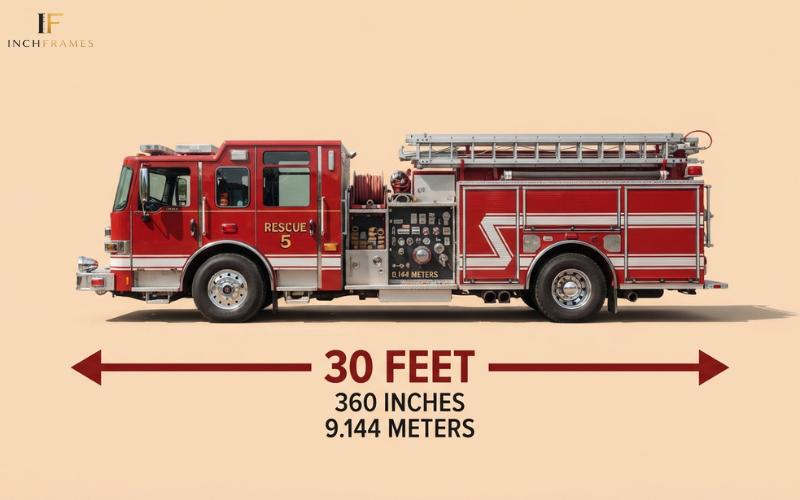
A large fire truck is around 30 feet long, depending on the type and equipment it carries. That puts many fire trucks reasonably close to the 30-foot mark.
Imagine one parked along a street. The front bumper might be about 30 feet from the rear of the vehicle on a model that matches this size. Its long body, equipment compartments, and cab make the full length easy to appreciate.
Ladder trucks can be especially large, while smaller fire engines may be shorter. That is why this is an approximate comparison. Still, if you have ever stood beside a large fire truck, you know it occupies a lot of space. It gives you a much better feel for 30 feet than simply looking at the number 30 on a page.
A Sailboat
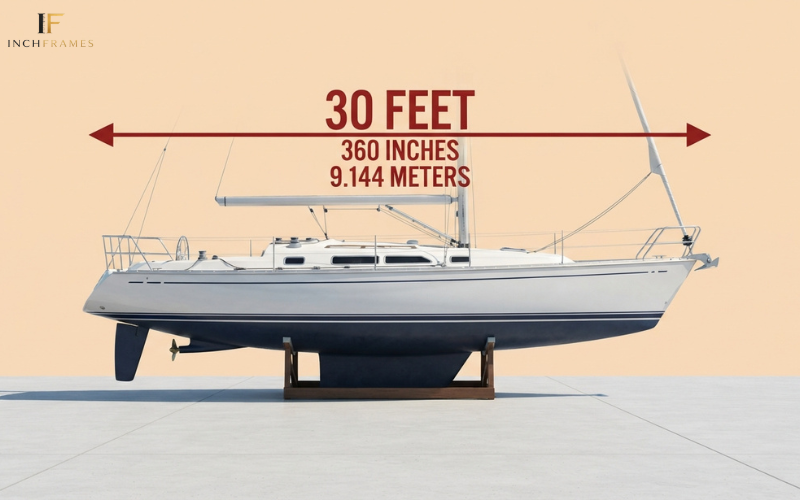
A 30-foot sailboat gives you an almost exact visual comparison when its listed length is 30 feet. The measurement normally runs from the front of the boat to the back of the hull.
Picture the boat sitting at a marina. If you walked along the dock beside it from bow to stern, you would cover 30 feet. That is equal to 10 yards or 9.144 meters.
The boat’s pointed bow can make the length look shorter from certain angles. From the side, however, the full distance is easier to appreciate. This makes a 30-foot sailboat a useful comparison for understanding how far 30 feet actually stretches. It is also a good example of why an object’s shape can affect how long it appears to your eyes.
A Large Pontoon Boat
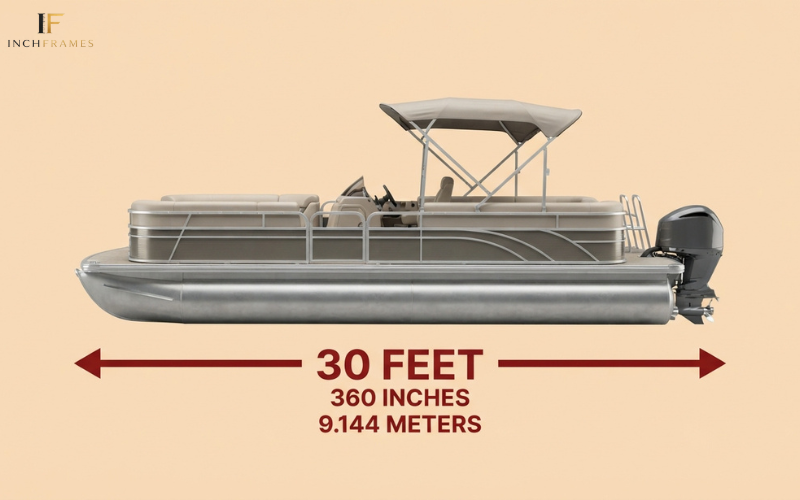
Large pontoon boats can reach around 30 feet, although many recreational models are shorter. A pontoon boat is particularly useful as a visual reference because its long, straight shape makes the front-to-back distance easy to see.
Imagine standing beside the boat at the dock. Walk from its front end toward the rear, and a large model could take you close to 30 feet. That is roughly 9.14 meters.
The exact length depends on the boat. Some pontoon boats are closer to 20 feet, while larger models can approach 30 feet or more. For that reason, this is an approximate comparison. Still, a large pontoon gives you a good sense of how much space a 30-foot object can occupy, especially when you see it next to people, docks, or other boats.
Related Post: How Long Is 15 Feet? 10 Everyday Things That Are 15 Feet Long
Two Average Cars End to End
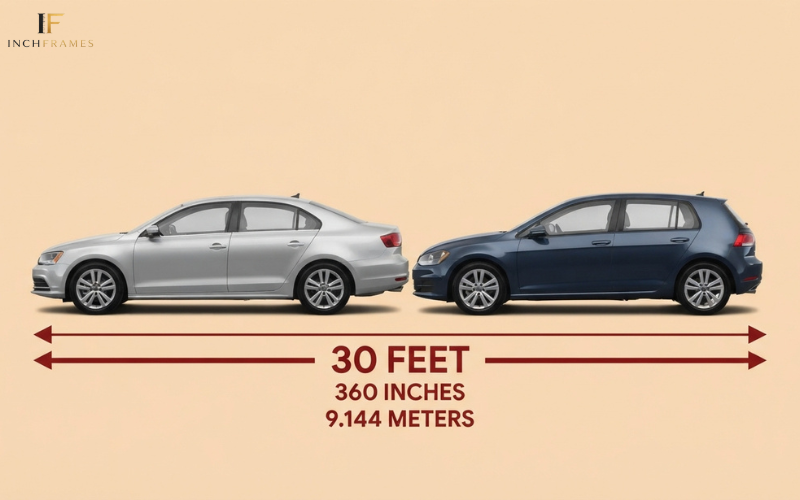
Two passenger cars parked bumper to bumper are one of the easiest ways to visualize 30 feet. Many ordinary cars are somewhere around 14 to 16 feet long, so two can total roughly 28 to 32 feet.
Imagine parking one car directly behind another without leaving a gap. From the front of the first car to the rear of the second, you would be very close to 30 feet.
The exact result depends on the vehicles. Two compact cars may be shorter, while two large SUVs may be longer. Even so, this comparison is useful because almost everyone knows how large a car looks. If you can picture two cars lined up, you can get a surprisingly good idea of the space covered by 30 feet.
Five Interior Doors End to End
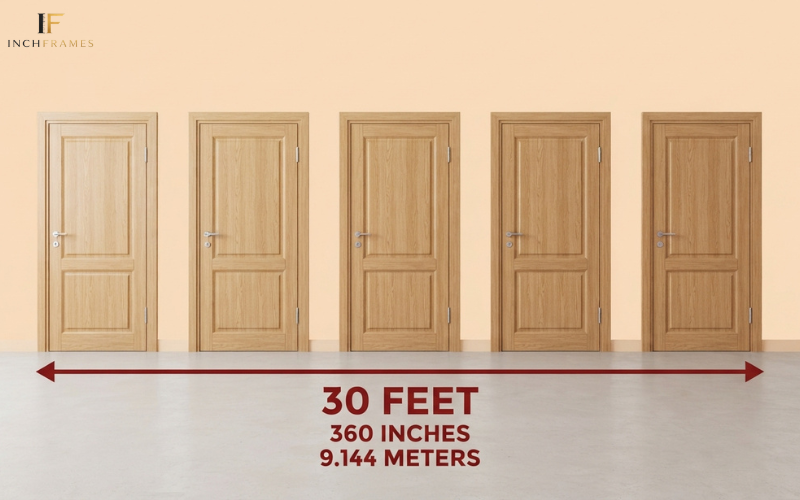
A typical interior door is about 80 inches tall, or 6 feet 8 inches. If five such doors were laid end to end, they would total about 33 feet 4 inches. That is a little longer than 30 feet, but still gives you a useful visual reference.
Imagine taking the doors off their hinges and placing them in a straight line on the floor. Five doors would create a surprisingly long stretch.
This example is helpful because the door size is familiar. Most people have walked through hundreds of doors without thinking about their measurements. Since five standard-height doors add up to more than 30 feet, you can think of 30 feet as slightly less than five doors laid end to end.
Three Large Sofas End to End
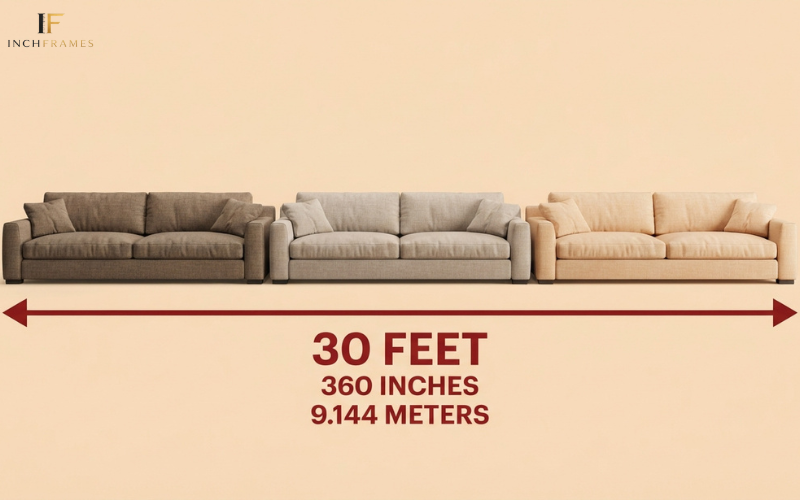
Large sofas can provide a practical furniture-based comparison. Depending on their design, a sofa may be around 8 to 10 feet wide. Three large sofas placed end to end could therefore reach roughly 24 to 30 feet.
Imagine lining three long sofas along one wall in a large room. The combined length would cover most of the room’s wall and could approach the full 30-foot distance.
This is not an exact comparison because sofas come in many sizes. A compact sofa might be much shorter, while a large sectional can be wider. Still, three large standard sofas give you a useful sense of scale. If you are planning furniture for a large room, thinking in terms of three sofa lengths can make a 30-foot wall easier to picture.
Row of 10 Shopping Carts
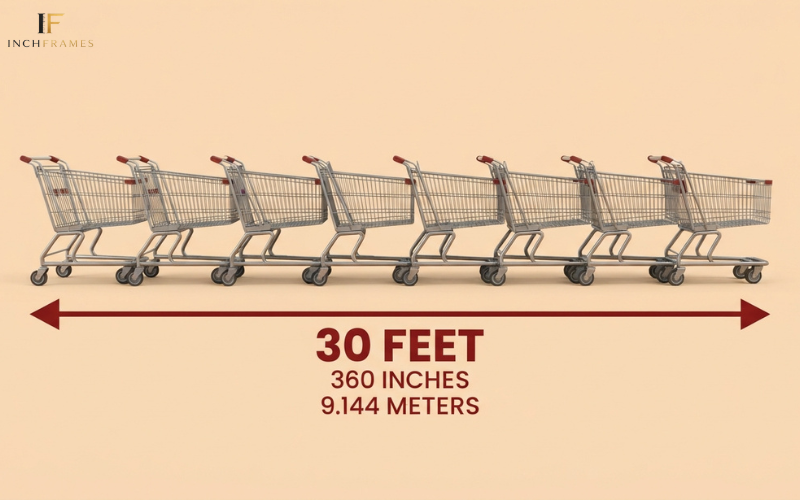
A row of shopping carts can create a useful visual estimate of 30 feet. A typical shopping cart is several feet long from its handle to the front basket and wheels. Ten carts arranged closely in a straight line can therefore stretch to roughly 30 feet, depending on the cart design and spacing.
Picture a supermarket employee lining carts up outside the store. A row of ten would take up a surprisingly large amount of sidewalk space.
This comparison is not meant to be an exact measuring method because shopping carts differ in size. It is simply a familiar way to understand the scale. If one cart represents roughly 3 feet, ten carts give you about 30 feet. The comparison becomes especially easy to understand when the carts are arranged in one straight line with little or no gap between them.
Two Parking Spaces End to End
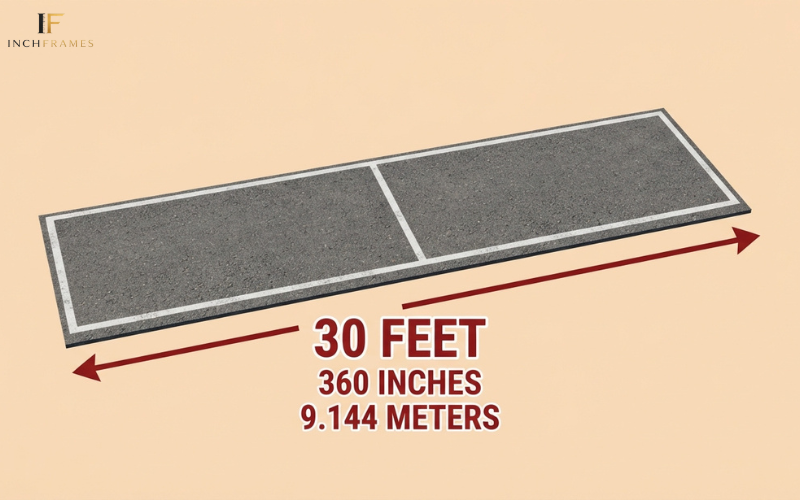
Two parking spaces placed lengthwise give you a quick way to picture a distance slightly longer than 30 feet. A common parking space is around 18 feet long, so two would be about 36 feet.
That makes this comparison useful because 30 feet is roughly five-sixths of the combined length of two such spaces. Imagine walking from the front of the first space to the back of the second. You would travel about 36 feet, meaning 30 feet would stop several feet before the end.
Parking spaces vary by location, so the exact measurement is not universal. Still, painted parking lines give you a familiar outdoor reference. If you can picture two spaces in a row, you can understand that 30 feet is a little shorter than their combined length.
Large Recreational Boat Trailer
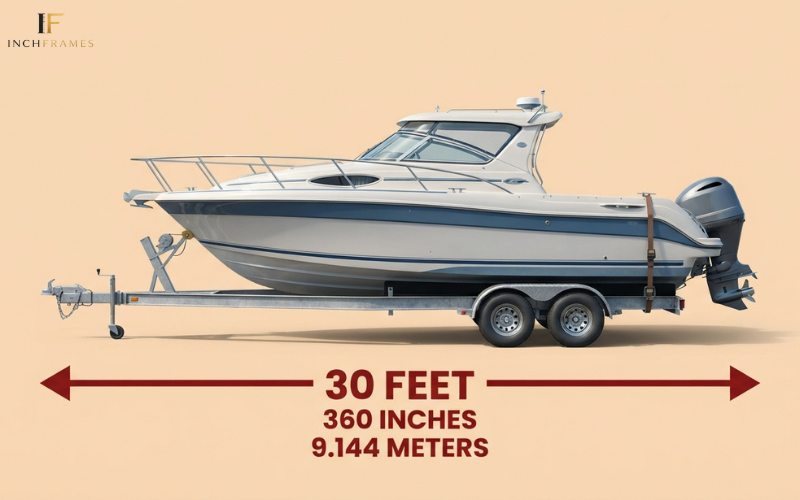
A large boat trailer can sometimes measure around 30 feet from its front hitch area to the rear. The exact length depends on the boat and trailer combination, but large setups can occupy a surprisingly long stretch of driveway.
Imagine a large recreational boat sitting on its trailer. From the hitch at the front to the back of the trailer, the complete setup can approach 30 feet.
This is a useful comparison for people who have seen boats being transported on roads. The trailer adds length beyond the boat itself, making the entire setup longer than it may first appear. It is still an approximate reference, not an exact 30-foot object. For a precise measurement, a tape measure is the better choice.
How to Measure 30 Feet Accurately
When accuracy matters, the best option is a measuring tape long enough to cover the full distance. A 30-foot tape measure is ideal because you can measure the entire length without having to move the tape several times.
Start at the exact point where the measurement should begin. Keep the tape straight rather than letting it curve across the floor or ground. Pull it tight enough to remove slack, but do not stretch a flexible tape so hard that it changes its position.
If your tape is shorter, you can measure in sections. For example, a 10-foot tape can be moved three times to cover 30 feet. Mark the end of each section before moving the tape. This method works, but small mistakes can add up.
For an outdoor space, you can also use a known object as a temporary guide. A standard 12-inch ruler, for example, represents exactly 1 foot. Thirty ruler lengths equal 30 feet, although using that method would be slow.
30 Feet in Feet, Inches, Yards, and Meters
Knowing the conversions makes it easier to switch between measurement systems.
- 30 feet = 360 inches
- 30 feet = 10 yards
- 30 feet = 9.144 meters
- 30 feet = 914.4 centimeters
- 30 feet = 9,144 millimeters
For everyday use, the most helpful conversion is often 30 feet to meters. It is about 9.14 meters. If you are working with a metric measuring tape, measuring 9.14 meters gives you the same distance.
It can also help to compare 30 feet with nearby measurements. For example, 20 feet is 240 inches, while 40 feet is 480 inches. So 30 feet sits exactly halfway between them. A distance of 25 feet is also useful to picture because 30 feet is only 5 feet longer.
If you prefer centimeters, remember that 1 foot equals 30.48 centimeters. Multiplying that by 30 gives 914.4 centimeters.
Related Post: How Long Is 20 Inches? 12 Everyday Things That Are 20 Inches Long
frequently asked questions
How long is 30 feet?
30 feet is 360 inches, 10 yards, or 9.144 meters. It is roughly the length of two average cars placed end to end.
Is 30 feet a long distance?
For an everyday indoor space, 30 feet is fairly long. It can span a large room, driveway, backyard, or similar outdoor area.
How many yards are in 30 feet?
There are 10 yards in 30 feet because 1 yard equals 3 feet.
How many inches are in 30 feet?
There are 360 inches in 30 feet. You get this by multiplying 30 feet by 12 inches per foot.
Is 30 feet the same as 10 meters?
No. 30 feet is 9.144 meters, so it is about 0.856 meter shorter than 10 meters.
How far is 30 feet when walking?
For many adults, 30 feet is roughly 12 to 15 normal walking steps, depending on stride length. This is only an estimate, not an accurate way to measure distance.
What is something that is about 30 feet long?
A 30-foot RV, large moving truck, long boat, or two average cars end to end can help you picture the measurement. A 30-foot extension cord or hose is an exact reference when fully stretched out.
How can I measure 30 feet without a tape measure?
You can estimate it with familiar objects or walking steps. For better accuracy, measure several smaller sections and add them together, such as three 10-foot sections.
Final Remarks
Thirty feet is a little over 9 meters, but the number becomes much easier to understand when you connect it to things you already know. A 30-foot extension cord gives you an exact reference, while two cars, a large RV, or a moving truck can help you picture the scale.
Remember the easiest conversions: 30 feet equals 360 inches, 10 yards, and 9.144 meters. If you are estimating, everyday objects work well. If the measurement needs to be exact, use a tape measure instead. A simple trick is to mark the beginning and end points first. That small step can prevent a surprisingly large measuring mistake.
