
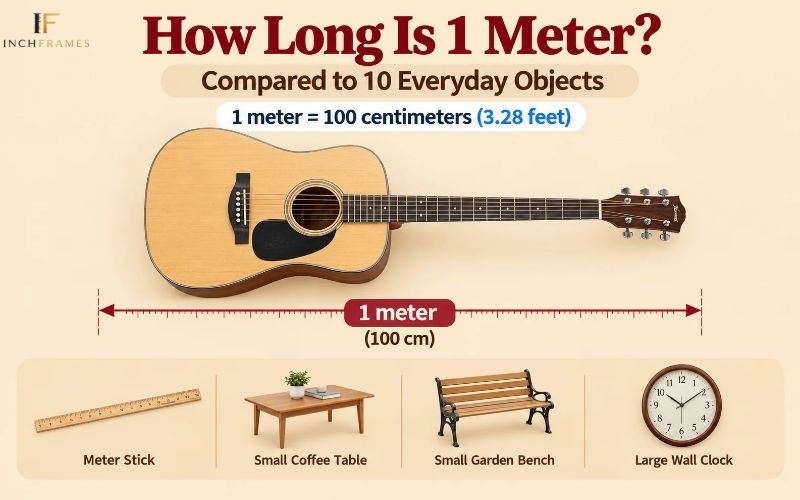
How Long Is a Meter? A meter is 100 centimeters, 1,000 millimeters, or about 39.37 inches long. In feet, one meter is about 3.28 feet, so it is a little longer than a 3-foot length. That gives you a useful starting point when trying to picture it.
A meter is not especially short or long. It sits in a handy middle range for everyday measuring. You might use meters to describe the size of a room, the length of furniture, the height of a person, or the distance between two points.
If you have ever wondered how long a meter actually looks, think about a little more than the width of a large doorway. You can also picture a long ruler or measuring stick stretched from one end to the other.
Most people find meters easier to understand once they connect the number to familiar objects. After seeing a few examples, you can usually make a fairly good estimate without reaching for a measuring tape.
How Long Is a Meter, Really?
One meter is exactly 100 centimeters. In the measurement system used in the United States, that is about 39.37 inches. So if you know what a 40-inch length looks like, you already have a close mental picture of a meter.
A meter is also 1,000 millimeters, which makes it useful for both larger and smaller measurements. For example, a carpenter might measure a length in meters, while a small part could be described in millimeters.
You can think of a meter as a little over three feet laid end to end. It is about the length of a guitar, the height of a kitchen counter from the floor, or the width of a comfortable walking space.
You will often see meters used for room dimensions, fabric, furniture, sports equipment, and outdoor distances. Once you recognize the size, the number becomes much less abstract.
Meters in Real-World Use
Meters are common whenever a measurement is too large for centimeters but still small enough to handle without kilometers. Builders may use meters when describing room dimensions, wall lengths, ceiling heights, or sections of flooring. A room might be several meters wide rather than hundreds of centimeters.
Meters also appear in sports and outdoor activities. Swimming pools, for example, are often described using meter lengths. A 25-meter pool has a swimming distance that is easy to compare once you understand the size of one meter.
In everyday planning, knowing one meter helps you estimate larger distances. Two meters is simply twice that length, while 5 meters gives you five meter-long sections placed together. That makes the basic unit useful far beyond a single measurement.
Everyday Objects That Are 1 Meter Long
The best way to understand a meter is to compare it with things you already see and use. The examples below are close to one meter, although exact sizes can vary by design or model.
| Everyday Object | Length |
|---|---|
| Meter Stick | 1 meter |
| Full-Size Acoustic Guitar | 1 meter |
| Small Coffee Table | 1 meter |
| Kitchen Counter Section | 1 meter |
| Small Garden Bench | 1 meter |
| Large Wall Clock | 1 meter |
| One Meter of Fabric | 1 meter |
| Garden Hose Section | 1 meter |
| Small Dining Table Width | 1 meter |
| Large Adult Step | 1 meter |
A Meter Stick
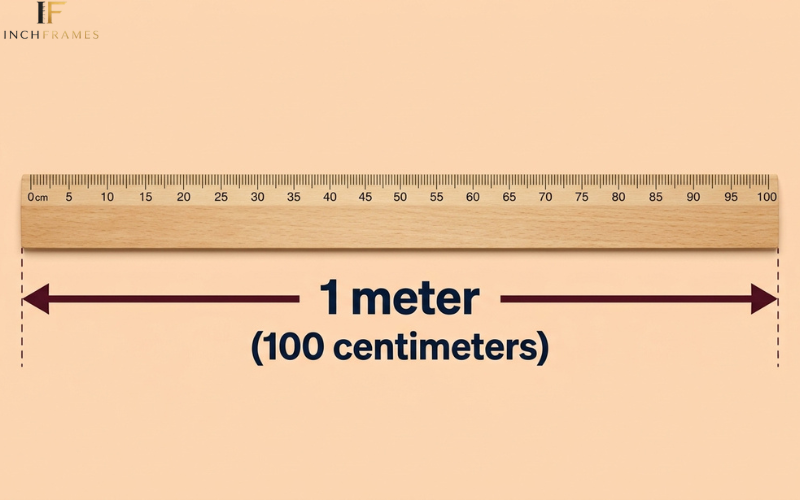
A meter stick is the most direct example of something that is one meter long.
It is made specifically for measuring one-meter lengths. You may see meter sticks in schools, workshops, laboratories, or craft areas. They are usually straight and marked with centimeters and smaller divisions.
A standard meter stick measures 100 centimeters from one end to the other. That gives you an exact reference rather than an estimate.
If you have one at home, spend a few seconds looking at it next to familiar objects. Compare it with your desk, chair, or arm. This can help you build a mental picture of one meter.
The next time you see a measurement of 1 meter online, you can think back to the stick. You do not have to memorize a complicated conversion.
For accurate work, a meter stick is much better than guessing from an everyday object.
Full-Size Acoustic Guitar
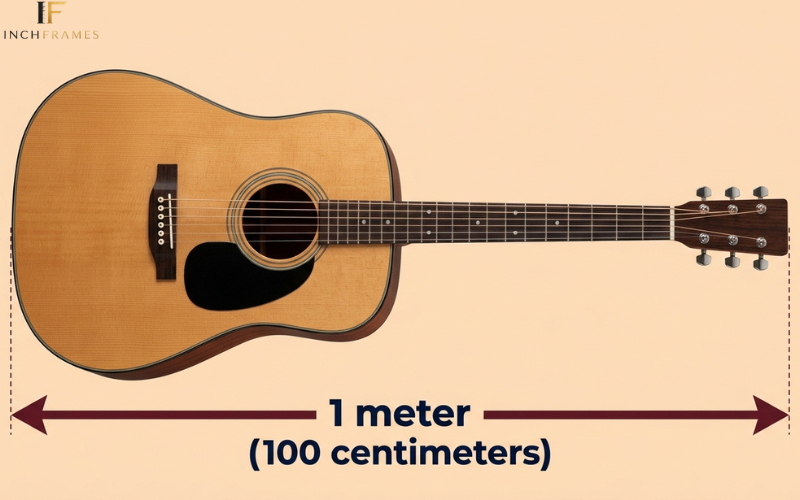
A full-size acoustic guitar can be close to one meter long, although the exact length depends on the model.
When you look at a guitar from the top of its headstock to the bottom of its body, the total length can give you a useful picture of one meter.
This does not mean every guitar is exactly 100 centimeters. Smaller guitars, travel guitars, and children’s guitars can be much shorter. Some larger instruments can also be longer.
Still, a full-size guitar is a good visual comparison because most people have seen one before. If you picture a guitar lying flat on the floor, its overall length is often in the neighborhood of one meter.
If you are buying or storing a guitar, use its actual listed dimensions. For simply understanding the size of a meter, though, a guitar makes a handy reference.
Related Post: 10 Everyday Things That Are 10 Centimeters Long
Small Coffee Table
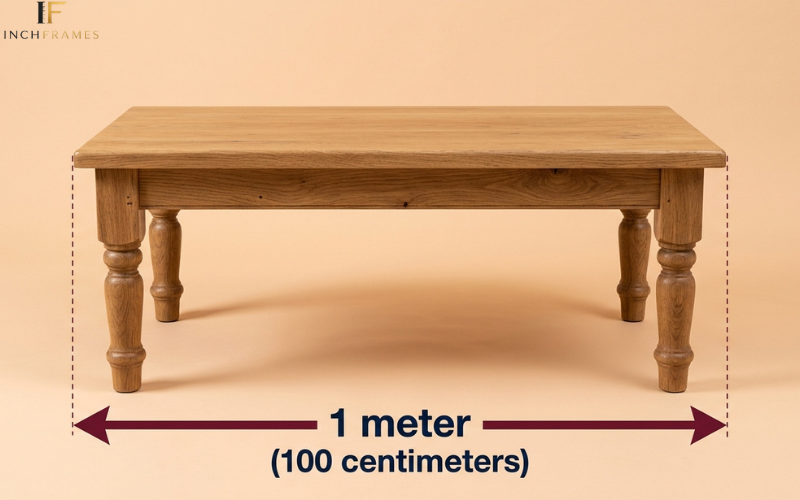
A compact coffee table can be around one meter across or long.
Imagine a small rectangular table measuring 100 centimeters from one side to the other. That distance is exactly one meter.
Of course, coffee tables come in many sizes. Some are smaller, while others are well over one meter long. The shape matters too. A square table may be close to one meter wide and one meter long, while a narrow rectangular table may have very different dimensions.
This is still a useful household comparison. Look at the tabletop in front of you and imagine a straight line from one end to the other.
If that line is about one meter, you now have a real-world picture of the measurement.
When shopping for furniture, always check the exact dimensions. A table that looks “about one meter” in a photograph may be quite different in real life.
Short Section of Kitchen Counter
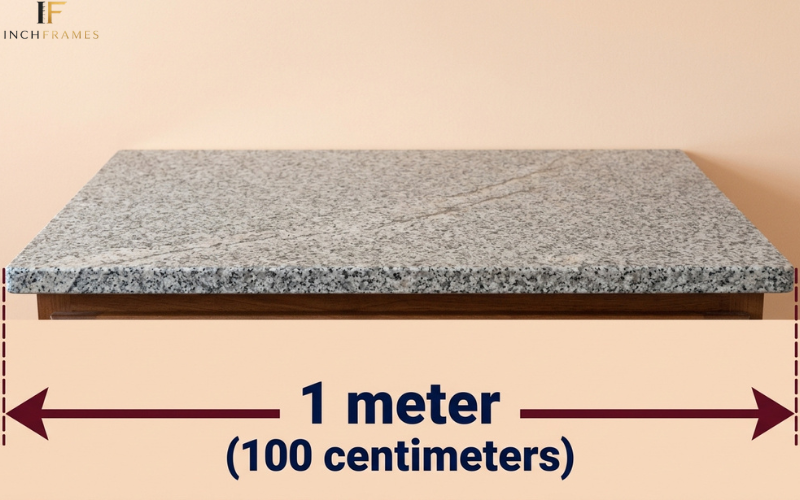
A kitchen counter can be several meters long, but a section measuring 1 meter gives you a clear idea of the length.
Imagine starting at one point on your countertop and measuring 100 centimeters along its front edge. That section is one meter.
This example is useful because counters are common in homes. You can see how one meter fits into a larger space without needing to imagine an unfamiliar object.
Do not confuse the counter’s length with its depth. A countertop may be around 60 centimeters deep, depending on the design. That is noticeably shorter than one meter.
This shows why measurements should always be connected to a direction. A measurement tells you how long one side is, not automatically how large the entire object is.
If you are cutting or installing a countertop, use a proper measuring tool. Even a small error can cause problems during installation.
Compact Garden Bench
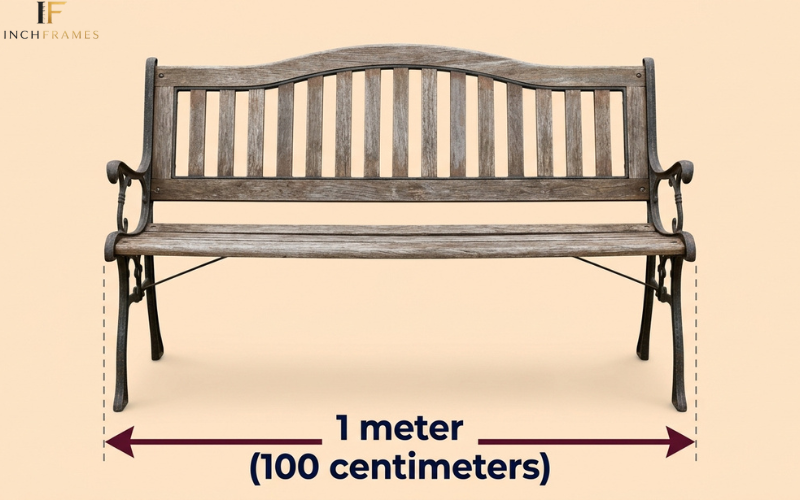
A small garden bench may be close to one meter long.
Garden benches are available in many sizes, so this is not an exact measurement for every bench. A small bench designed for one person may be around this length, while a larger bench can be much longer.
Imagine measuring from the left end of the seat to the right end. If the distance is about 100 centimeters, the bench is about one meter long.
This comparison is especially useful if you are planning a garden, balcony, porch, or small outdoor sitting area.
You can also use a bench to understand how much space one meter takes up. A meter may not sound like much, but when you place a piece of furniture in a narrow area, that distance can matter.
For an exact fit, measure the bench and the available space before buying or moving anything.
Large Wall Clock
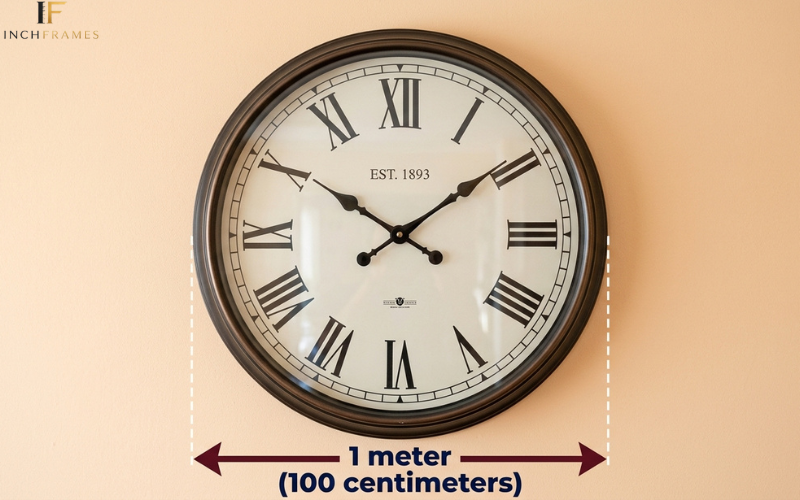
Some large decorative wall clocks can be close to one meter across.
This measurement is called the diameter when the clock is round. If the distance from one side of the clock to the other, passing through the center, is 100 centimeters, its diameter is one meter.
Most household clocks are much smaller than this. Large clocks of this size are more common in spacious homes, offices, restaurants, schools, and public buildings.
A big round clock is a useful comparison because you can see the whole meter at once. Imagine stretching a measuring tape from the left edge to the right edge.
The important thing to remember is that a meter describes the distance, not the shape. A one-meter line could be straight, curved, part of a circle, or part of a larger object.
That makes the meter a flexible measurement for many different uses.
See Also: 10 Everyday Things That Are 11 Feet Long
One Meter of Fabric
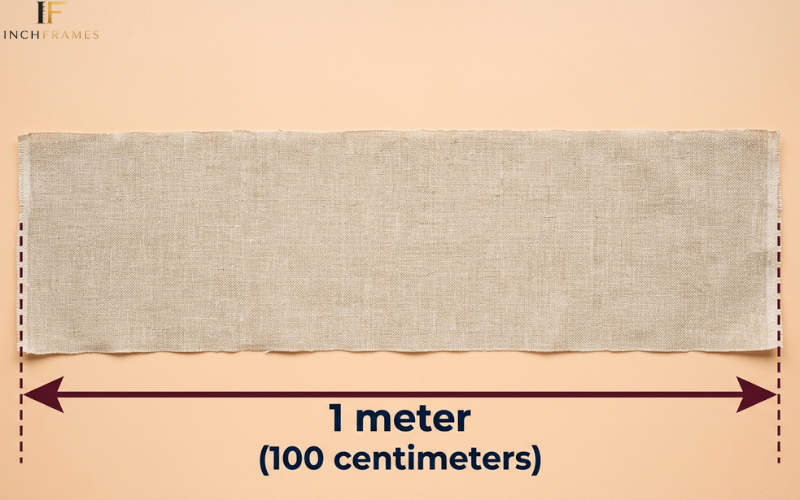
Fabric is often sold by length, which makes it a practical example of a meter.
If you buy one meter of fabric, the length of the cut piece is 100 centimeters. However, its width depends on the fabric. A piece could be one meter long and much wider than half a meter.
This distinction is important when sewing or making crafts. Saying “one meter of fabric” tells you the length, but you should also check the fabric width.
You might see fabric sold in half-meter sections or several-meter rolls. Once you know that one meter equals 100 centimeters, these measurements become easier to understand.
For example, half a meter is 50 centimeters. Two one-meter pieces would give you 2 meters, or 200 centimeters.
If you are following a sewing pattern, use the measurements given in the instructions rather than estimating by eye.
Straight Section of Garden Hose
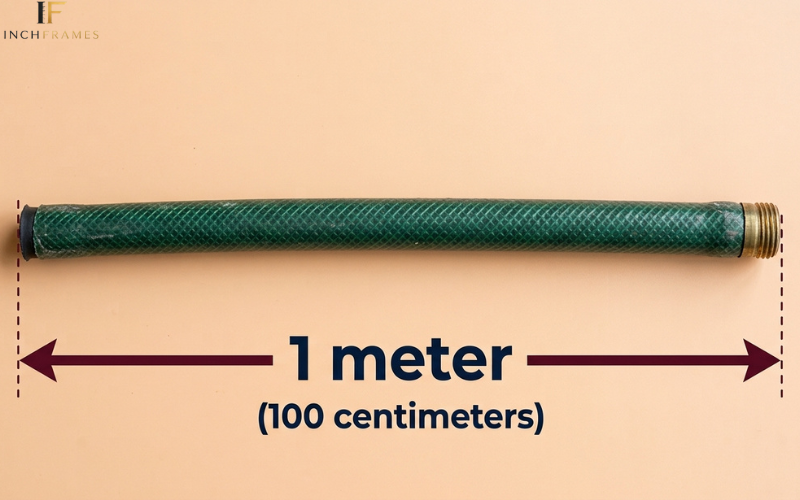
A one-meter section of garden hose is another easy example.
A hose is flexible, so it needs to be straightened before measuring. If you stretch it straight and measure 100 centimeters from one end to the other, you have one meter of hose.
This is a useful reminder that an object’s shape can change how long it looks. A hose curled into a coil may appear very short, even though it contains several meters of material.
You may use meters when buying hose for gardening, water systems, crafts, or other home projects.
If you need an exact amount, measure the distance between the two points you need to connect. Do not rely on a visual estimate alone.
For a mental picture, however, imagine a straight piece of hose extending a little farther than a 3-foot section. That is close to one meter.
Small Dining Table Width
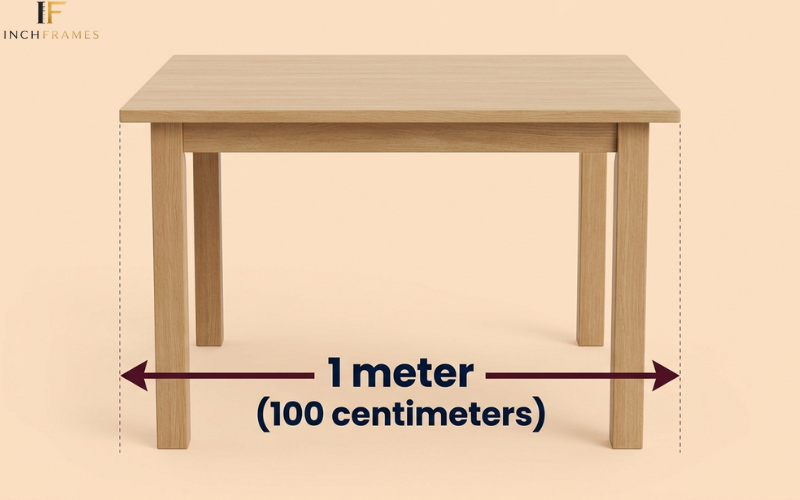
The width of a compact dining table can be around one meter.
This is different from saying that the whole table is one meter long. A table might be 100 centimeters wide but 150 centimeters long, for example. The two measurements describe different sides.
This makes a dining table a helpful way to understand how measurements work in real life.
Stand at one side of a table and look straight across to the opposite side. If that distance is close to 100 centimeters, you are looking at about one meter.
A one-meter table width can also help when planning a dining area. You need to think about the table itself plus enough space around it for chairs and people to move.
If you are checking whether a table will fit in your room, measure both the table and the open floor space. Pictures can be misleading.
One Large Adult Step
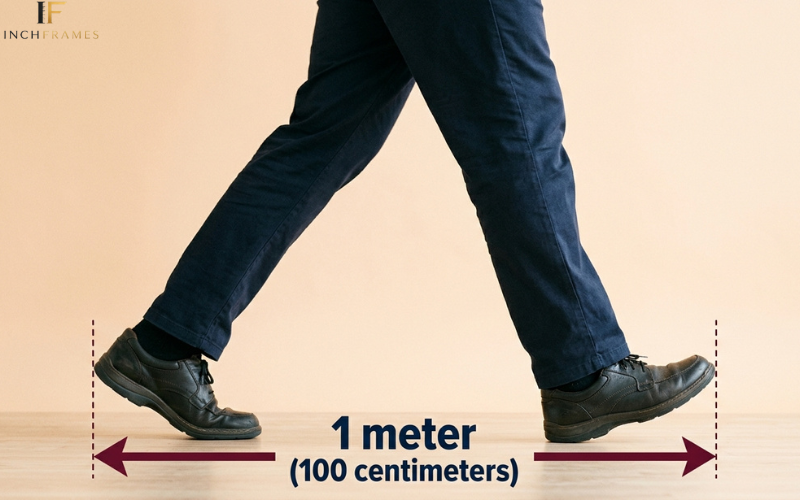
One large adult step can sometimes be close to one meter, but this is only a rough comparison.
Your step length depends on your height, walking style, and how large a step you take. A child and an adult will usually have different step lengths.
You can test your own step. Walk normally and measure the distance covered by one comfortable stride. Once you know your average step length, you can use it as a quick estimating tool.
For example, if your stride happens to be close to one meter, five large steps would give you a rough idea of 5 meters.
Do not use this method when exact measurements matter. It is useful for estimating distance outdoors or getting a quick sense of scale.
I like this comparison because you always have your own steps with you. No ruler is needed.
How Can You Picture One Meter Without a Ruler?
You can use several familiar objects to estimate one meter.
Use a yardstick
A yardstick is 36 inches long. A meter is about 39.37 inches. So a meter is a little longer than a yardstick.
Imagine adding about 3.37 inches to the end of the yardstick. You are now very close to one meter.
Use A4 paper
A4 paper is 29.7 centimeters long on its longer side. Three sheets placed end to end would measure 89.1 centimeters.
You would need another 10.9 centimeters to reach 100 centimeters.
This is a good visual trick if you have paper nearby.
Use a door
A typical interior door can be around 80 inches tall, although door sizes vary. One meter is about 39.37 inches, which is close to half of an 80-inch door.
Imagine dividing the door’s height into two nearly equal sections. One section gives you a rough picture of one meter.
Use a dollar bill
A U.S. dollar bill is about 6 inches long. Six bills placed end to end measure 36.84 inches, which is fairly close to one meter.
You still need about 2.53 inches to reach 39.37 inches.
These comparisons are useful for estimating, not for precise work. If you are cutting wood or installing furniture, use a measuring tape.
Why Is One Meter a Useful Measurement?
A meter is useful because it sits between small and very large measurements.
You would not normally measure a phone in meters. You might use centimeters or inches instead. Likewise, you would usually use meters rather than centimeters when measuring a room, piece of furniture, garden area, or length of fabric.
Online shopping is another place where meters and centimeters can be helpful. A product may list its size as 1 meter, 100 centimeters, or 39.37 inches. These measurements describe the same length.
Once you understand the basic conversion, you can compare products more easily.
For DIY projects, a mental picture of a meter can also help you plan before measuring. You may look at a wall and estimate that you have about 2 meters of open space. Then you can confirm the exact distance with a tape measure.
The estimate helps you think. The tape measure confirms it.
See Also: How Long Is 15 Feet? 10 Everyday Things That Are 15 Feet Long
Frequently Asked Questions
How long is a meter in feet?
One meter is approximately 3.28 feet. That is a little longer than 3 feet.
How many centimeters are in a meter?
There are exactly 100 centimeters in one meter. This is one of the easiest meter conversions to remember.
How many inches is one meter?
One meter equals approximately 39.37 inches. It is slightly shorter than 40 inches.
Is a meter longer than a yard?
Yes. One meter is about 1.09 yards, so it is slightly longer than one yard.
What does 1 meter look like?
One meter is about the length of a meter stick or a long guitar. It is also a little longer than a 3-foot ruler.
Can I measure a meter without a measuring tape?
Yes. You can estimate it using your arm length, walking step, or a known object. These methods are useful for rough measurements but are not suitable when exact accuracy matters.
Is 100 cm the same as 1 meter?
Yes. 100 centimeters equals exactly 1 meter. You can remember it as 100 cm = 1 m.
Why is the meter used for measuring?
The meter is the basic unit of length in the metric system. It provides a convenient size for measuring everyday objects, rooms, distances, and many other things.
Conclusion
If you searched “How long is a mater?”, you most likely meant “How long is a meter?” One meter is exactly 100 centimeters and about 39.37 inches. It is a little longer than a yard and just over 3 feet.
The easiest way to remember it is to connect the number with something familiar. Picture a meter stick, a full-size guitar, a small table, or a short section of kitchen counter. Even six dollar bills placed end to end can bring you surprisingly close.
You do not need to memorize every conversion. Remember that a meter is about 39 inches long. That simple reference can help you estimate sizes when you are shopping, planning a project, or trying to understand measurements. When the job needs to be exact, though, grab a tape measure and check it.
