
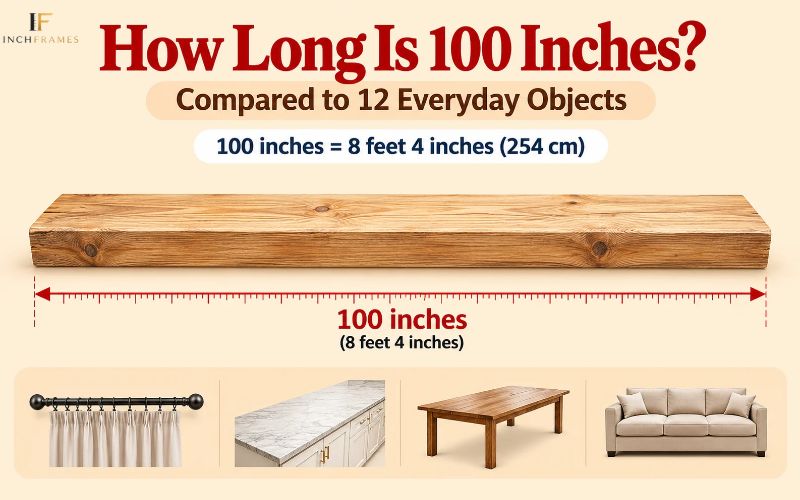
How long is 100 inches? 100 inches is 8 feet 4 inches long, which is equal to 254 centimeters or 2.54 meters. It is a little longer than an ordinary 8-foot board and shorter than a 9-foot span. Although 100 inches may sound like a large number, it becomes easier to picture when you compare it with familiar household items, furniture, and building materials.
Think about a long dining table, a sofa, or a wooden plank. If one of these items measures exactly 100 inches along its longest side, it gives you a practical way to understand this length. The key is to measure the correct dimension because objects can have different lengths, widths, and heights.
In this guide, you will learn what 100 inches looks like, how it compares with other measurements, and how 12 everyday objects can represent this exact length. You will also find simple ways to estimate 100 inches without a measuring tape and answers to common measurement questions.
How Long Is 100 Inches, Really?
100 inches is equal to 8 feet 4 inches, 254 centimeters, or 2.54 meters. It is a little more than 8 feet long, making it a useful measurement for visualizing large furniture, long household fixtures, and other everyday objects. Imagine placing eight 12-inch rulers end to end, then adding another 4 inches. Together, they would cover exactly 100 inches.
This length is longer than a standard 6-foot folding table and shorter than a 10-foot span, which measures 120 inches. It can help you picture the width of a large dining table, the length of a wooden plank, or the overall size of a long shelf when the item is specifically measured to 100 inches.
Keep in mind that everyday objects do not all come in this exact size. A sofa, mattress, bookshelf, or countertop can have different dimensions depending on its design and manufacturer. In this guide, each example represents an item measured or made to exactly 100 inches. The goal is to make the measurement easier to understand through familiar objects rather than assume every item of that type has the same length.
100 Inches in Real-World Use
A length of 100 inches can be useful in many everyday situations. For example, it can describe the length of a long dining table, the overall width of a large sofa, or the length of a wooden plank made for a specific project. It can also be used when planning a countertop, a shelf, or a fence section.
However, not every item in these categories has a standard length of exactly 100 inches. Products vary by design and manufacturer. To use an object as an accurate example, its measured dimension must be 100 inches from one end to the other.
This measurement is especially useful when buying furniture or preparing building materials because even a small difference can affect whether an item fits in the space you have available.
Everyday Things That Are 100 Inches Long
The following 12 objects can each represent a length of exactly 100 inches when their specified longest dimension is measured or made to that size. The table lists the required measurement for every item.
These are exact-length examples, not claims that all products in these categories are manufactured at 100 inches.
| Item | Length |
|---|---|
| Wooden Plank | 100 inches |
| Curtain Rod | 100 inches |
| Countertop | 100 inches |
| Workbench | 100 inches |
| Sofa | 100 inches |
| Carpet Runner | 100 inches |
| Wall Shelf | 100 inches |
| Bed Mattress | 100 inches |
| Dining Table | 100 inches |
| Bookshelf | 100 inches |
| Adjustable Extension Pole | 100 inches |
| 100-Inch TV | 100 inches |
Wooden Plank
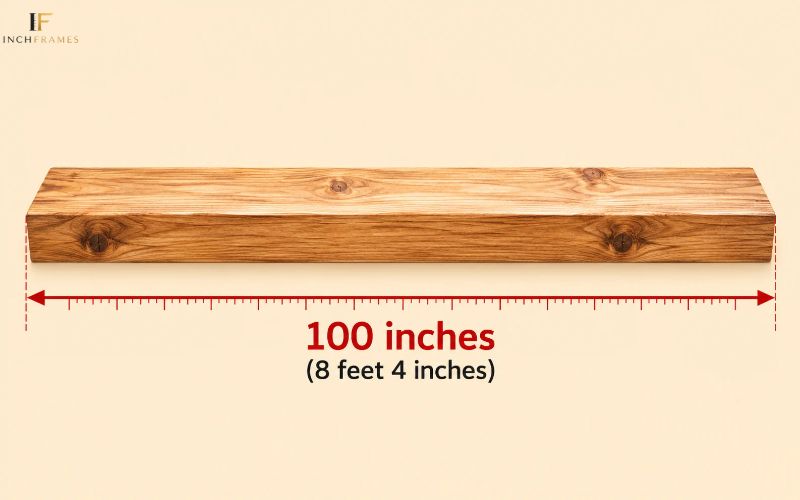
A wooden plank cut to exactly 100 inches is a straightforward way to picture this measurement. It is 8 feet long plus another 4 inches. This type of plank can be used for suitable woodworking, shelving, framing, or other home projects, depending on its thickness and strength.
To confirm the length, place the plank on a flat surface and measure along its longest edge from one end to the other. The measurement should reach exactly 100 inches. Do not assume that every plank sold as an 8-foot board is 100 inches long. An 8-foot board is normally 96 inches, so a 100-inch plank is 4 inches longer.
This comparison makes the difference between 8 feet and 100 inches easy to understand.
Curtain Rod
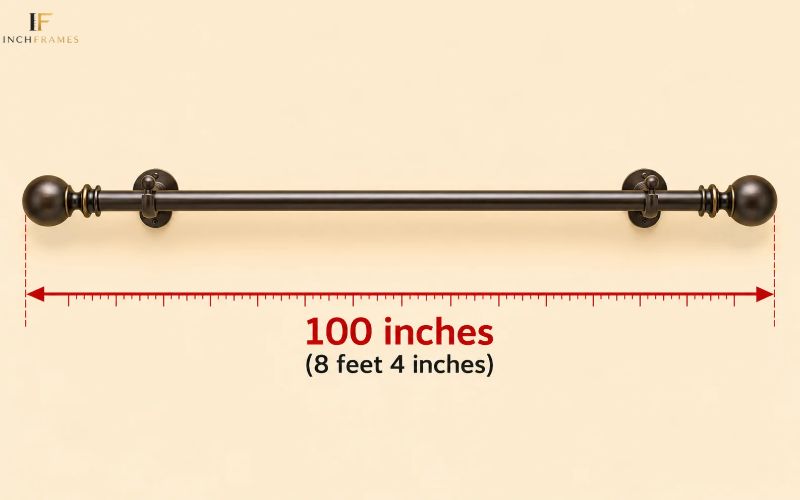
A curtain rod set or cut to exactly 100 inches provides another familiar household comparison. The length is measured along the rod itself, from one end to the other, rather than across the wall or between the mounting brackets.
Curtain rods are available in many lengths, and some adjustable models can be extended to different sizes. For this example, the rod must be set to exactly 100 inches. A rod of this length may suit a wide window or a larger window arrangement, depending on the room and installation.
If you are buying one, check the product’s minimum and maximum lengths. Also consider how much the rod should extend beyond the window frame. The exact rod length and the width of the window opening are two different measurements.
Related Post: How Long Is 90 Inches? Compared to 12 Everyday Objects
Countertop
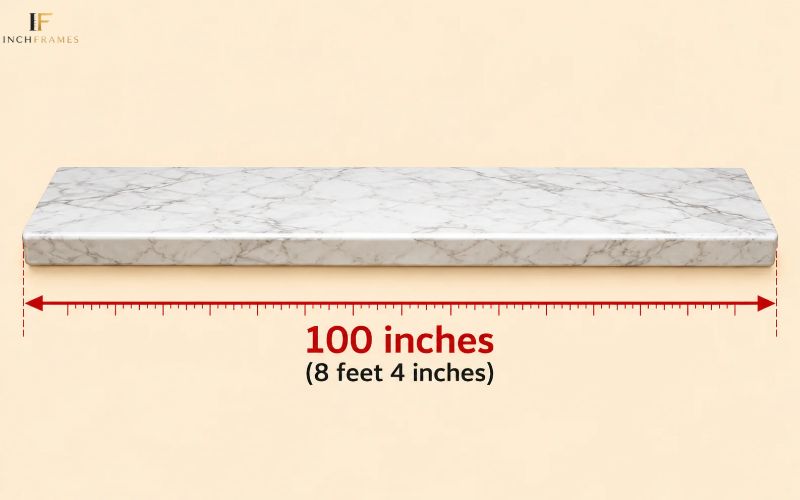
A countertop made to measure 100 inches long can help you picture this span in a kitchen, utility room, or workshop. To measure it accurately, follow the longest horizontal edge from one end to the other. The countertop’s depth and thickness are separate dimensions.
Countertops come in many shapes and sizes, so 100 inches is a specified measurement for this example rather than a universal countertop length. A countertop cut to this size could be used in a custom layout if the available room and cabinet arrangement allow it.
When planning a countertop, remember to measure the available wall or cabinet space carefully. Also account for corners, sinks, appliances, and any required gaps. The finished countertop should be checked before installation to make sure its actual length is exactly 100 inches.
Workbench
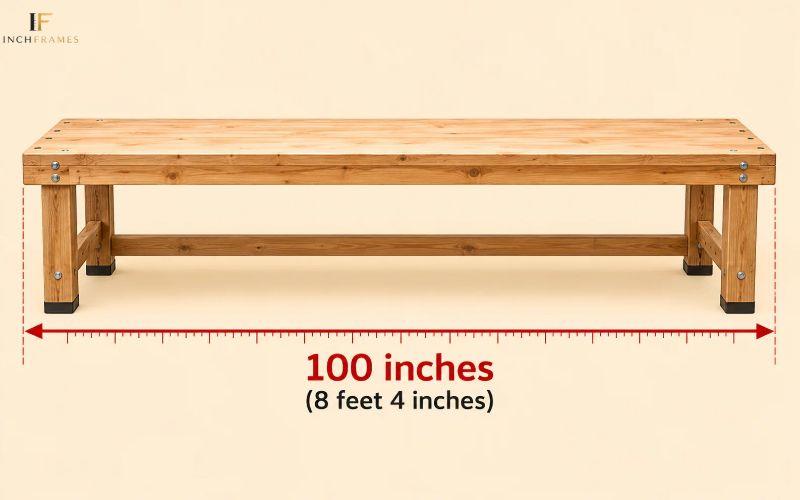
A workbench with a tabletop measuring exactly 100 inches from end to end offers a useful example of a long working surface. It is 8 feet 4 inches long, making it slightly longer than an 8-foot work surface.
The measurement should refer to the tabletop’s longest dimension, not its height or depth. Workbenches differ widely according to their purpose. A small home repair bench may be much shorter, while a custom workshop bench can be made to a longer specification.
A 100-inch workbench may provide space for tools, materials, or a longer project, depending on its depth and construction. If you are planning to build one, measure the top after cutting and before assembly. That way, you can confirm the finished length rather than relying on the planned dimensions alone.
A Sofa
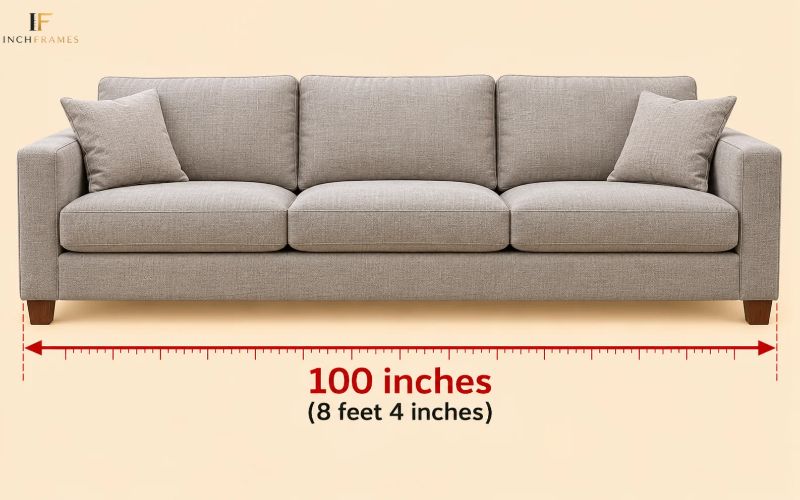
A sofa measuring exactly 100 inches across its outer edges is another useful way to picture this length. This measurement equals 8 feet 4 inches. It refers to the sofa’s total outside width from its leftmost edge to its rightmost edge, including the arms where applicable.
Sofas vary in design, so a large sofa should not automatically be assumed to be 100 inches long. For this example, the manufacturer’s dimensions or a tape measure must confirm the exact 100-inch span. The seating area between the arms may be shorter than the overall width.
Before placing a sofa in a living room, measure the wall and the available floor area. Also check doorways, staircases, and hallways through which the sofa must pass. Its overall length is only one of the dimensions needed to determine whether it will fit comfortably.
Carpet Runner
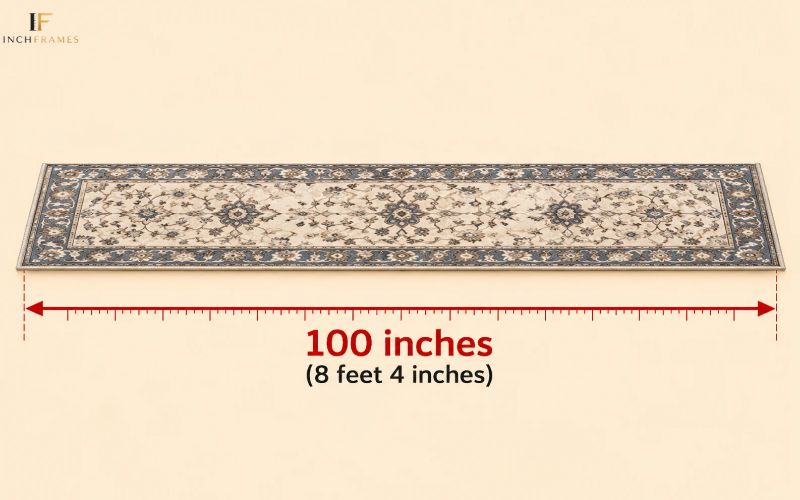
A carpet runner cut to exactly 100 inches long measures 8 feet 4 inches from one short end to the other. A runner is a narrow carpet often placed in a hallway, entryway, or beside a bed. Its width is separate from its length.
Carpet runners are available in various sizes, so not every runner will measure 100 inches. For this example, the finished runner must have an exact length of 100 inches. This gives you a simple way to imagine the measurement along a floor.
If you are choosing a runner for your home, measure the area where it will sit. Leave enough space at each end and check that doors can open freely. If the runner is cut from a larger piece of carpet, measure the finished edge after cutting to confirm the exact length.
Related Post: How Long Is 80 Inches? Compared to 13 Everyday Objects
Wall Shelf
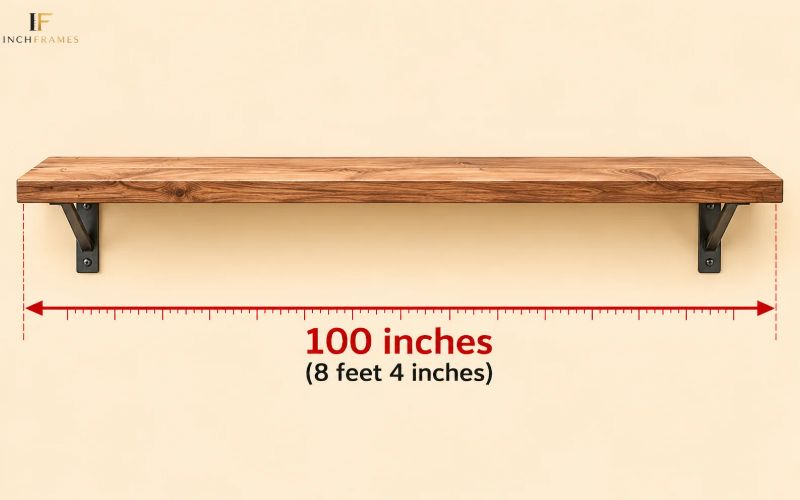
A wall shelf that measures exactly 100 inches along its front edge is a long shelf designed for a specific space. It is 8 feet 4 inches long, so it extends 4 inches beyond the length of a standard 8-foot measurement.
A shelf of this size might be used in a storage area, workshop, or room with a long wall. Its suitability depends on its depth, thickness, material, and the weight it needs to hold. A long shelf may require several properly installed supports to prevent bending or sagging.
To confirm the length, measure the shelf from its left edge to its right edge. Do not include extra space between the shelf and the wall or any separate mounting hardware. Since shelves come in many sizes, check the actual product specifications or measure the finished shelf to ensure it is exactly 100 inches long.
Bed Mattress
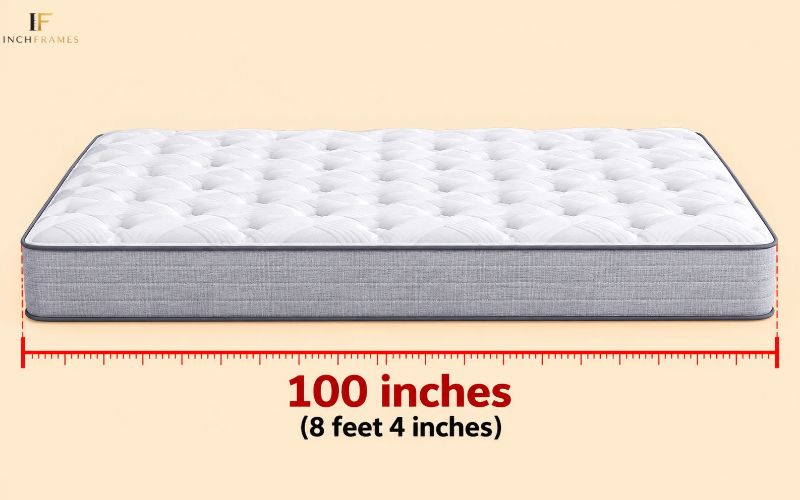
A bed mattress measuring exactly 100 inches long provides another way to visualize this measurement. It equals 8 feet 4 inches, or 254 centimeters. To check its length, measure from the top end to the bottom end along its longest side. The width and thickness are separate measurements and should not be included in the length.
Mattress dimensions vary according to the type, design, and manufacturer. A standard mattress should not automatically be assumed to measure 100 inches long. For this example, the mattress must have a verified length of exactly 100 inches. This is longer than many common mattresses, so it would generally require a specially sized mattress and a suitable bed frame.
If you need a mattress for a particular bed, check the manufacturer’s dimensions before buying. Matching the mattress to the frame helps prevent gaps or overhang. A tape measure is the easiest way to confirm the actual length.
Dining Table
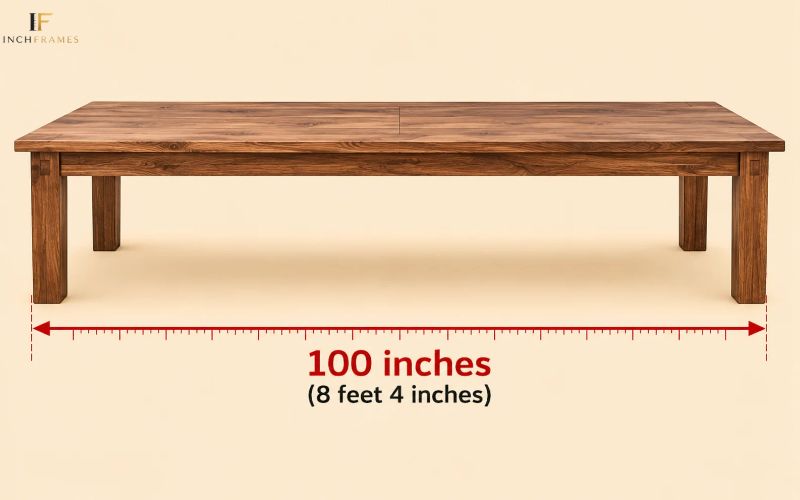
A dining table with an overall tabletop length of exactly 100 inches is a practical example of this measurement. To check it, measure from one short end of the tabletop to the other along its longest side. The result should be 100 inches, equal to 254 centimeters.
Dining tables are made in many sizes, and their dimensions depend on the design and number of seats. Not every large dining table measures 100 inches long. For this example, the table’s longest tabletop dimension must be exactly 100 inches. Its width and height do not change the length.
A table of this size can take up a considerable amount of room. Before buying one, measure the available floor space and allow room for chairs and people to move around. Checking the table’s listed dimensions helps ensure it will fit the intended dining area.
Bookshelf
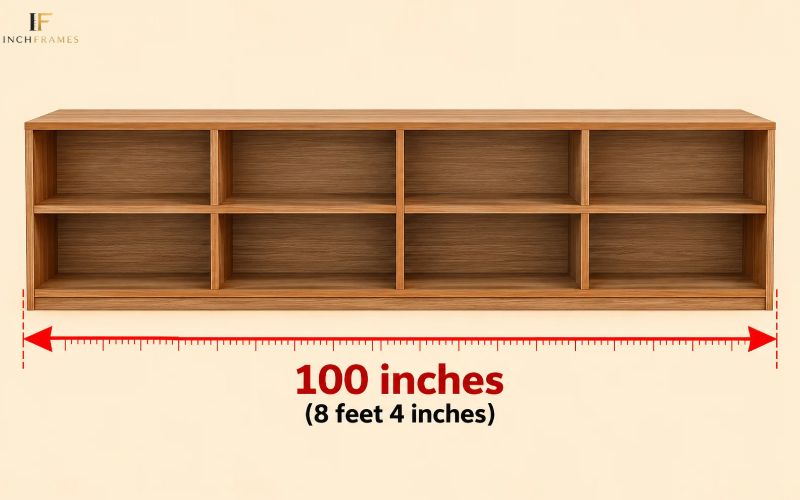
A bookshelf measuring exactly 100 inches long is a useful example of this measurement in a home. It equals 8 feet 4 inches, 254 centimeters, or 2.54 meters. To measure it accurately, measure the bookshelf’s longest horizontal dimension from its leftmost edge to its rightmost edge. This refers to the overall width of the bookshelf, not its height or depth.
Bookshelves come in many different sizes, so not every bookshelf will measure 100 inches. For this example, the bookshelf must be made or selected with an overall width of exactly 100 inches. A bookshelf this wide can provide space for books, decorations, storage baskets, and other household items, depending on its design and shelf arrangement.
Before purchasing one, measure the wall or floor space where you plan to place it. Also check the height and depth to make sure it fits comfortably. Measuring the full width helps you understand how much space a 100-inch object occupies in a room.
Related Post: How Long Is 50 Inches? Compared to 13 Everyday Objects
Adjustable Extension Pole
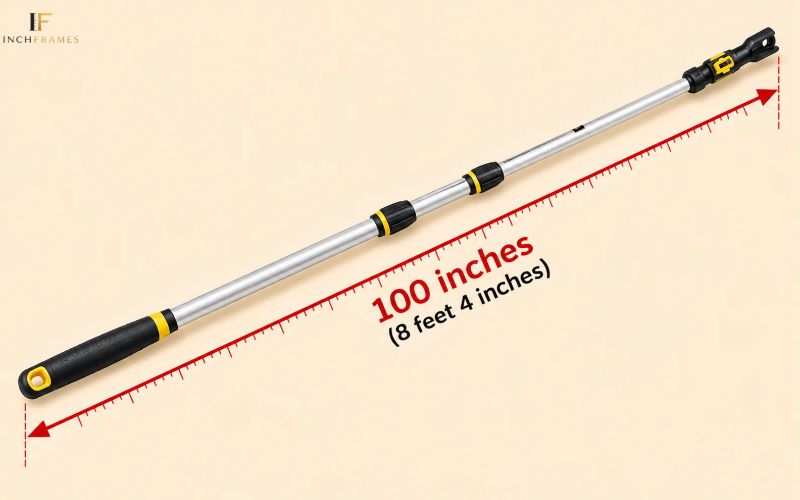
An adjustable extension pole set to exactly 100 inches is a final example of this length. Extension poles are used for tasks such as reaching high surfaces, painting, cleaning, or attaching certain tools. Their total length can vary depending on the model and how far the pole is extended.
For this comparison, extend the pole to a measured length of 100 inches from one end to the other. That is the same as 8 feet 4 inches or 254 centimeters. Do not assume every extension pole can reach this length; check its listed range before using it as an example.
If you measure the pole, keep it straight and follow the manufacturer’s instructions for safe extension and locking. Some poles include attachments that add to the total reach, so decide whether you are measuring the pole alone or the complete tool. Use the same measurement method consistently.
100-Inch TV
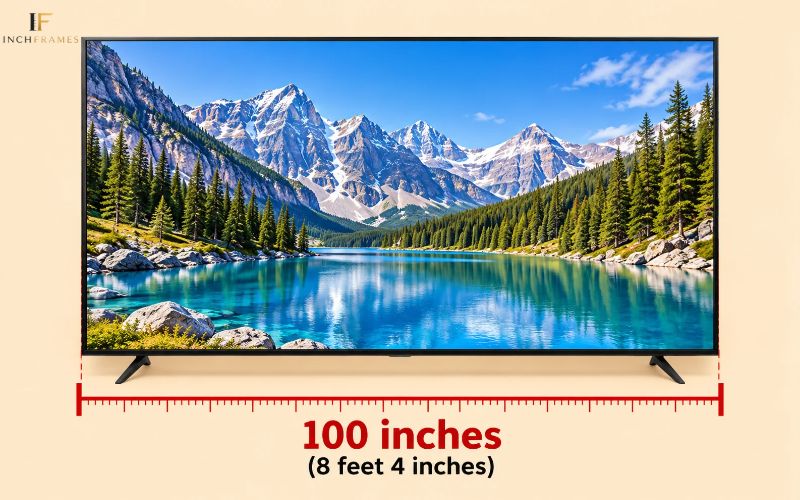
A 100-inch TV is a useful example for understanding a large measurement, but there is one important detail: TV sizes are measured diagonally across the screen, not horizontally from one side to the other. A TV advertised as 100 inches has a screen diagonal of 100 inches, equal to 8 feet 4 inches or 254 centimeters.
For a typical 16:9 widescreen TV, the screen is approximately 87.2 inches wide and 49 inches tall, excluding the frame and stand. This means its horizontal width is shorter than 100 inches, even though its diagonal measurement is exactly 100 inches. The actual outside dimensions may vary slightly by model.
A TV of this size can make a big impression in a spacious living room or home theater. Before buying one, measure the wall and available viewing space. Remember to check the manufacturer’s listed width, height, and depth to make sure the TV fits comfortably.
How to Measure 100 Inches Without a Ruler
You can estimate 100 inches without a ruler, but the result will be approximate unless you use a measuring tool.
- Use an 8-foot reference: Eight feet equals 96 inches. Imagine or mark that length, then add another 4 inches.
- Use a known 10-foot span: Ten feet equals 120 inches. A 100-inch length is 20 inches shorter.
- Measure with a tape measure: A flexible tape marked in inches is the simplest way to check an object accurately. Extend it along the object’s longest dimension.
- Mark and compare: If you have a known 100-inch object, use it as a reference for another item, making sure both are laid straight.
For furniture or building materials, use an actual measuring tape rather than relying on estimates. Small errors can matter when an item needs to fit a particular space.
Why Exact Measurements Matter
Knowing that an object is 100 inches long can help with furniture placement, home improvement, and material planning. However, the measurement must refer to the correct dimension. A sofa’s overall width, for example, is different from its seat width, while a countertop’s length is different from its depth.
Product listings may round dimensions or give measurements in feet, inches, or centimeters. Since 100 inches equals 254 centimeters, these values can be used to cross-check a specification. Also remember that 8 feet equals only 96 inches, so an item described as 8 feet long is not automatically 100 inches long.
For a precise fit, measure the actual item or confirm the manufacturer’s stated dimensions before buying or cutting materials.
See Also: How Long Is a Meter? Compared to 10 Everyday Objects
Frequently Asked Questions
How many feet is 100 inches?
100 inches equals 8 feet 4 inches, or approximately 8.33 feet. Eight feet accounts for 96 inches, and the remaining 4 inches complete the measurement.
Is 100 inches longer than 8 feet?
Yes. Eight feet equals 96 inches, so 100 inches is 4 inches longer than 8 feet.
How many centimeters is 100 inches?
100 inches equals 254 centimeters. To convert inches to centimeters, multiply the inch measurement by 2.54.
Is 100 inches the same as 2.5 meters?
Not exactly. 100 inches equals 2.54 meters, which is 4 centimeters longer than 2.5 meters.
Can a dining table be exactly 100 inches long?
Yes. A dining table can be made or sold with a tabletop measuring exactly 100 inches long. However, you should check the actual specifications because dining tables come in many sizes.
Can a sofa measure 100 inches?
Yes. A sofa can have an overall width of exactly 100 inches. Measure from its outermost left edge to its outermost right edge to confirm the total length.
What is the easiest way to measure 100 inches?
A tape measure marked in inches is the easiest option. Lay it straight along the object and measure from one end to the other.
How does 100 inches compare with 10 feet?
Ten feet equals 120 inches, so 100 inches is 20 inches shorter than 10 feet. This makes 100 inches a little over 8 feet but noticeably shorter than 10 feet.
Final Thoughts
100 inches is equal to 8 feet 4 inches, 254 centimeters, or 2.54 meters. It is longer than an 8-foot span by 4 inches, making it a useful measurement to understand when planning furniture, home projects, and other everyday tasks.
A wooden plank, curtain rod, countertop, workbench, pipe, carpet runner, shelf, fence rail, dining table, sofa, garden edging strip, or extension pole can each represent this exact length when its specified dimension is measured or made to 100 inches. The important point is to check the actual measurement rather than assume every item of that type has the same size.
When accuracy matters, use a tape measure and check the exact dimension you need. That small step can help you avoid buying an item that is too long, cutting material incorrectly, or misjudging the space available.
