
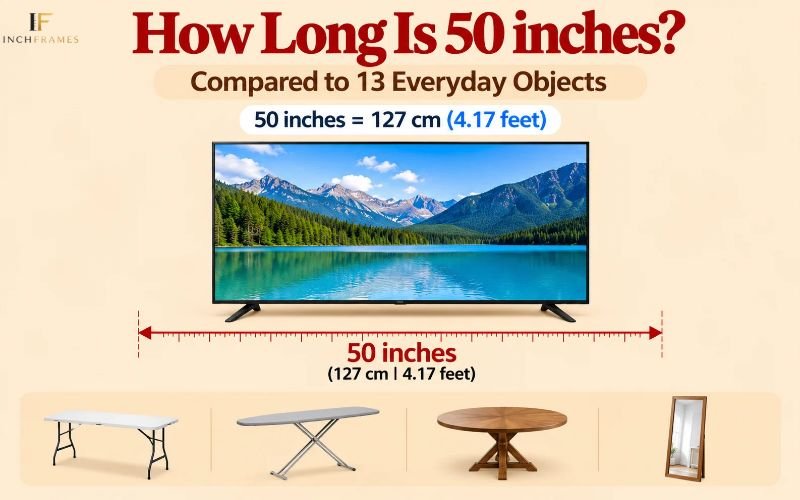
50 inches is exactly 127 centimeters, or 4 feet 2 inches. That makes it a little over 4 feet long and much easier to picture when you compare it with familiar objects.
A 50-inch measurement can show up in many places around your home. You might see it when checking the size of a television, measuring a table, choosing a shelf, or figuring out whether a piece of furniture will fit in a certain space. It is long enough to be noticeable but still small enough to fit across many household items.
The tricky part is that 50 inches can describe length, width, height, or even the diagonal of an object. A 50-inch TV, for example, is measured diagonally rather than straight across its front. So the number does not always tell you exactly how an object will look.
A few everyday references can make 50 inches much easier to picture. Once you have those references in mind, estimating this length becomes much simpler.
How Long Is 50 Inches, Really?
50 inches measures 127 centimeters and equals 4 feet 2 inches. If you prefer meters, that is 1.27 meters. So you can picture 50 inches as a little longer than a 4-foot distance.
Another useful way to think about it is to split the measurement into smaller pieces. A 50-inch length is 10 inches longer than 40 inches and 2 inches shorter than 52 inches. You could also think of it as four sections of 1 foot plus another 2 inches.
A 50-inch distance can stretch across a good part of a kitchen counter or desk. It can also be close to the width of some furniture pieces. If you have ever measured a space with a tape measure, you know that even a few inches can make a difference when deciding whether something will fit.
50 Inches in Real-World Use
Fifty inches is useful when planning spaces where furniture, fixtures, or equipment need to fit within a set area. For example, you might measure a wall before buying a shelf or check the available floor space before choosing a table.
It can also matter when mounting a television or arranging a work area. A measurement of 50 inches gives you a little over 4 feet to work with, which is enough space for many medium-sized household items.
Another place you may see 50 inches is in product dimensions. Manufacturers often give several measurements for an item, such as width, height, and depth. If one of those measurements is close to 50 inches, knowing what that distance looks like can help you judge the item’s size before buying it.
Everyday Things That Are 50 Inches Long
Fifty inches is about 4 feet 2 inches, so it is a useful size to compare with medium and large household objects.
The objects below are not all exactly 50 inches. Their actual dimensions vary by model and design, but they can give you a practical idea of the length. Some are close to 48 inches, while others can reach or exceed 50 inches.
| Everyday Thing | Approximate Length |
|---|---|
| Folding Table | About 48 inches |
| 50-Inch Television | About 48 inches |
| Standard Ironing Board | About 48 inches |
| Long Curtain Rod | About 48 inches |
| Large Wall Shelf | About 48 inches |
| Four-Foot Bench | About 48 inches |
| Round Dining Table | About 48 inches |
| Large Full-Length Mirror | About 48 inches |
| Four-Foot Workbench | About 48 inches |
| Wide Bookshelf | About 48 inches |
| Kitchen Counter Section | About 50 inches |
| Large Storage Shelf | About 48 inches |
| Folding Room Divider | About 48 inches |
Folding Table
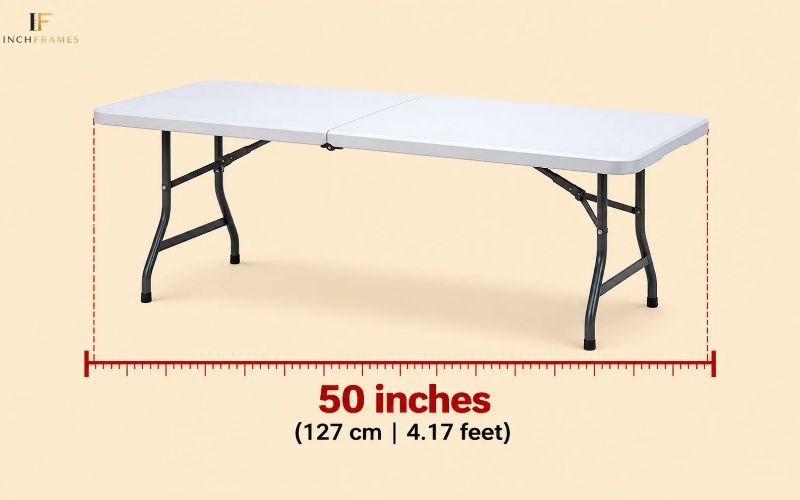
A 50-inch folding table is one of the easiest ways to understand a measurement close to 50 inches. Many folding tables are made around 4 feet long, which puts them just 2 inches shorter than 50 inches.
Picture the table stretched out in front of you. Its long side would cover almost the entire 50-inch distance. That small 2-inch difference is hard to notice without a ruler or tape measure.
Folding tables are common at family gatherings, school events, garage sales, and outdoor parties. You may also see them used as temporary workspaces. Because they are familiar and have a clear straight edge, they make a good reference when you are trying to estimate how long 50 inches really is.
50-Inch Television
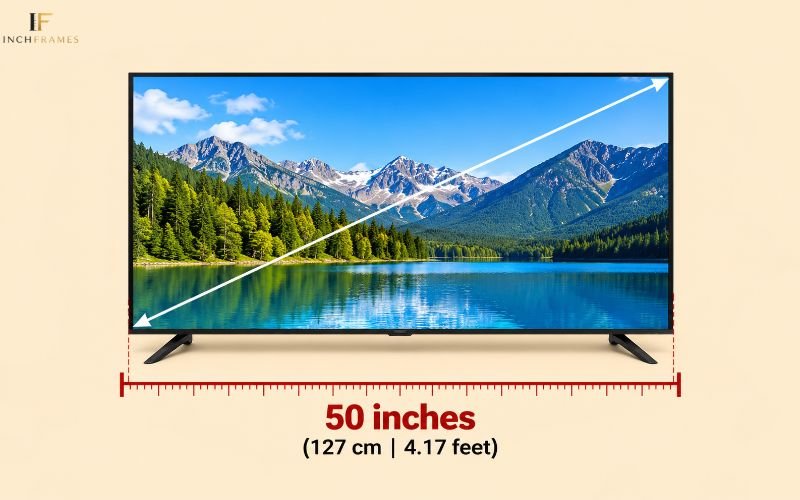
A 50-inch television gives you another familiar comparison, but there is one detail to remember: the 50-inch measurement refers to the diagonal screen size, not the straight width.
A typical 50-inch TV screen is roughly 44 inches wide, depending on its aspect ratio and design. That means its diagonal is 50 inches, while the horizontal width is somewhat shorter.
This makes a television a useful reference for understanding how measurement terms work. If someone says they bought a 50-inch TV, you should not expect the screen to be 50 inches from left to right. The number describes the diagonal from one corner to the opposite corner.
Most people are surprised by this the first time they learn it. It is a good reminder to check which dimension a measurement describes.
Related Post: How Long Is 30 Inches? (Compared to 14 Everyday Objects)
Standard Ironing Board
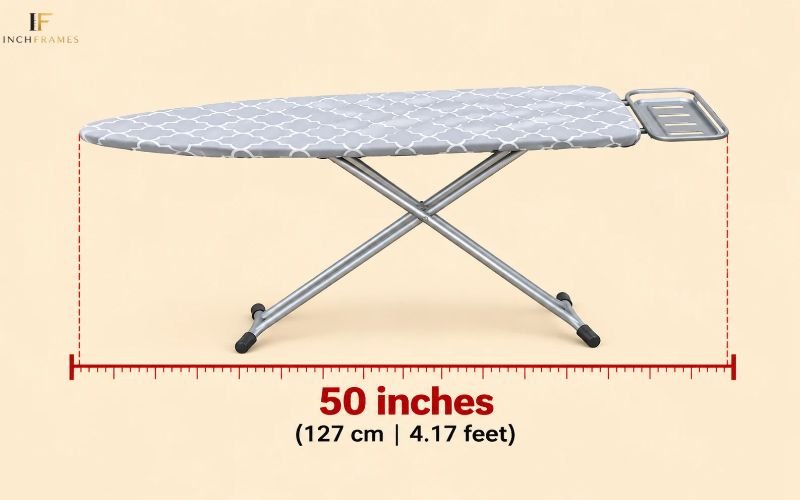
A full-size ironing board can be close to 50 inches long, making it a handy household reference for 50 inches. The exact size depends on the board, but many full-size models stretch to around 4 feet or a little more.
Imagine opening an ironing board and measuring from the pointed end to the opposite end. That distance gives you a strong visual idea of what 50 inches looks like.
Ironing boards are also easy to picture because their shape is long and narrow. Unlike a wide piece of furniture, you can clearly see the length from one end to the other. If you have one at home, you can use it as a quick comparison when estimating a measurement close to 50 inches.
Long Curtain Rod
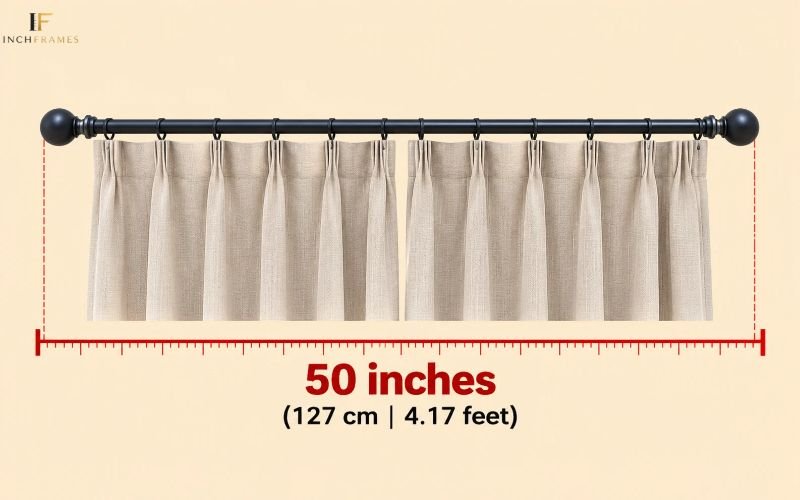
A long curtain rod can be another useful reference for 50 inches. Many curtain rods are adjustable, and some common sizes can extend to around 48–50 inches or more.
Picture a rod stretched straight across a window. If it measures close to 50 inches, it would span just over 4 feet from end to end. That gives you a simple way to visualize the distance without needing to imagine a bare number.
Curtain rods are especially useful for home measurements because they are straight and easy to compare. You might measure a window before buying one, so a measurement near 50 inches can become familiar pretty quickly.
Large Wall Shelf
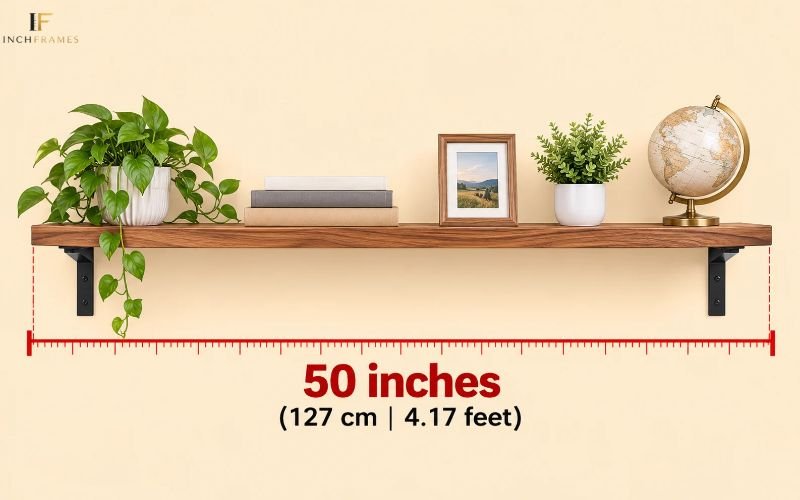
A large wall shelf can measure around 48–50 inches wide. A shelf this size gives you a good sense of how much horizontal space 50 inches covers on a wall.
Imagine placing a shelf across a blank wall. At roughly 4 feet 2 inches long, it would be wide enough to hold several books, small plants, framed photos, or decorative items.
The important thing here is the width rather than the depth. A shelf might only be 8–12 inches deep while being nearly 50 inches wide. That difference shows why you should always check which dimension a product listing is talking about.
A Bench
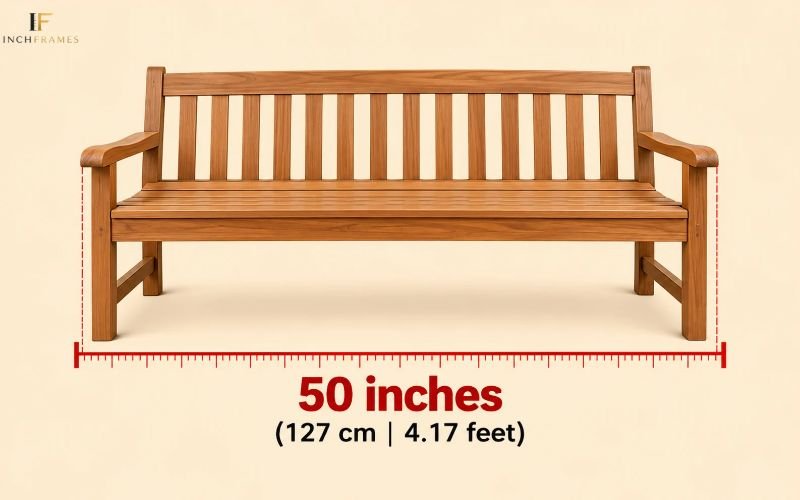
A simple four-foot bench is another close comparison. Four feet equals 48 inches, which is only 2 inches shorter than 50 inches.
That small difference makes a 4-foot bench a particularly useful mental reference. If you have seen a bench that comfortably seats two or three people, picture extending its length by another 2 inches. You would be very close to 50 inches.
Benches of this size can be found in entryways, gardens, bedrooms, patios, and waiting areas. Their straight shape also makes the length easy to see. When you hear that something is 50 inches long, thinking of a four-foot bench plus a couple of extra inches can give you a quick estimate.
Related Post: How Long Is 50 Feet? Compared to 15 Everyday Objects
Round Dining Table
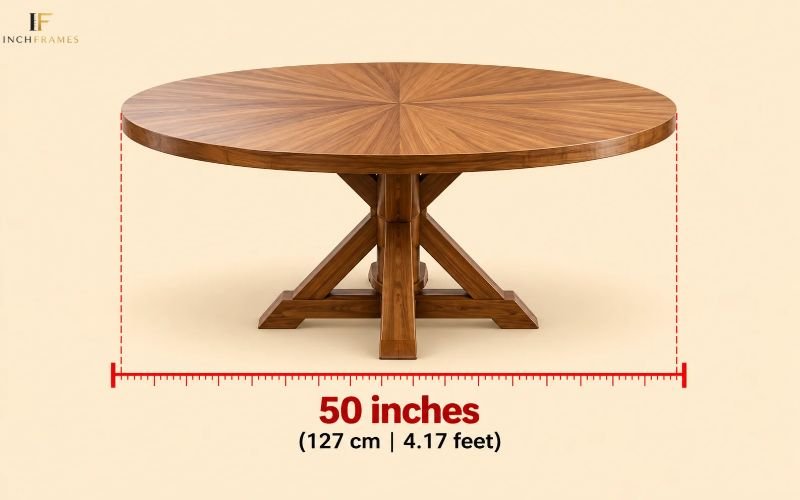
A round dining table with a diameter close to 48–50 inches gives you a different way to understand the measurement. Instead of being a straight object, the table uses the measurement from one side of the circle to the other.
A 50-inch diameter means the distance across the center of the tabletop is 50 inches. That is just over 4 feet, so the table would take up a noticeable amount of floor space.
A table around this size can work well for several people, depending on its design. When you see one in a dining room, imagine measuring directly across its center. That distance can give you a much better sense of what 50 inches looks like in a real room.
Large Full-Length Mirror
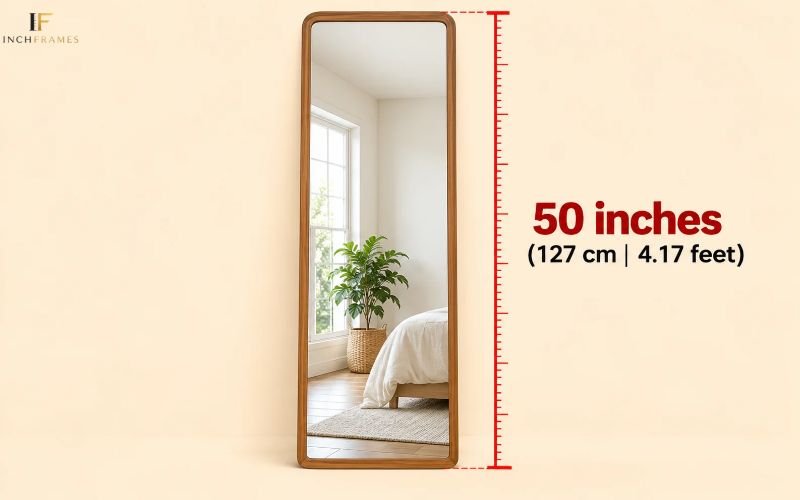
A large full-length mirror can be around 48–50 inches tall, depending on its design. This makes it useful for picturing 50 inches vertically rather than horizontally.
Imagine placing a tape measure from the floor upward. At 50 inches, you would reach a point a little more than 4 feet above the floor. A mirror that is around this height can cover a substantial part of a wall without reaching all the way to the ceiling.
Full-length mirrors are common in bedrooms, dressing areas, clothing stores, and hallways. They are also a good reminder that the same measurement can be viewed in different directions. Fifty inches does not have to run across an object; it can also describe its height.
Workbench
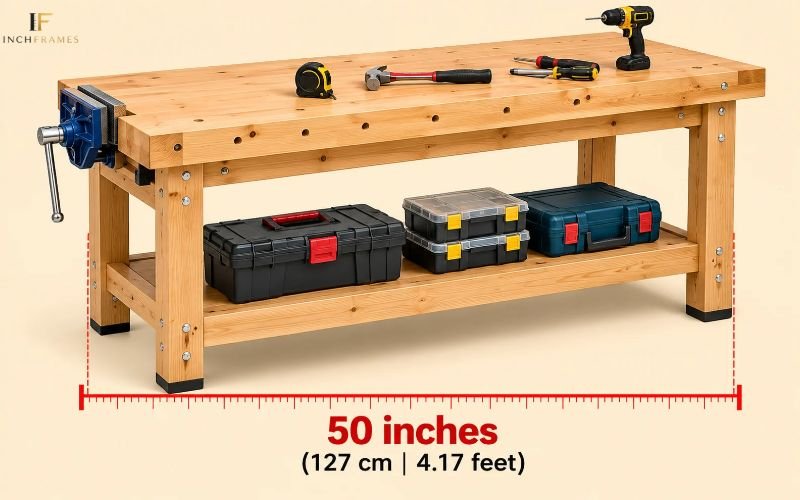
A small workshop workbench around 48–50 inches long is another practical comparison. Many compact benches are designed around the 4-foot range, giving you a useful reference that is only a couple of inches shorter than 50 inches.
Picture the bench sitting against a garage wall. Its long surface would stretch just over 4 feet, giving you enough room for basic tools, small repairs, or hobby projects.
The workbench is helpful because it connects the measurement to usable workspace. If you are planning a garage or workshop, knowing what 50 inches looks like can help you decide how much wall or floor space a bench will need.
Wide Bookshelf
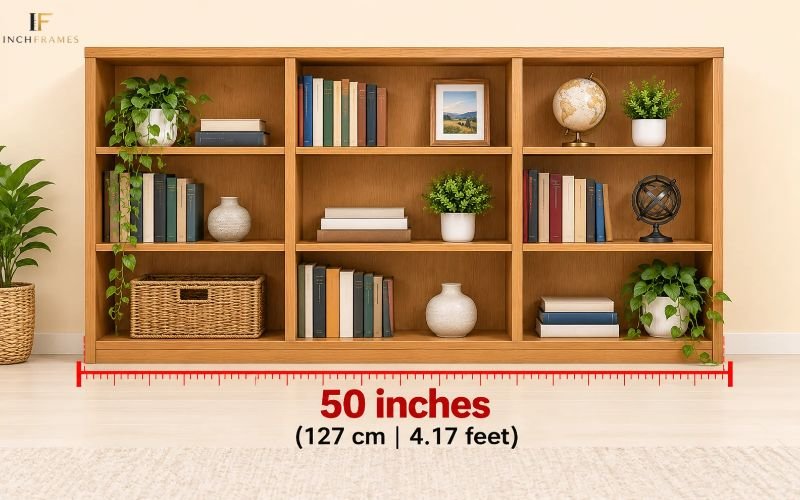
A wide bookshelf can be close to 48–50 inches across. This is a useful comparison because bookshelves are common in homes, classrooms, offices, and libraries.
Imagine looking at a bookshelf that is about 4 feet wide. From one side panel to the other, the distance would be close to 50 inches. You could easily see how much wall space the shelf would occupy.
The actual width of bookshelves varies a lot, so it is better to treat this as an approximate reference. Some are much narrower, while large units can be considerably wider. Still, a shelf around 50 inches wide gives you a clear idea of how far the measurement stretches across a wall.
Kitchen Counter Section
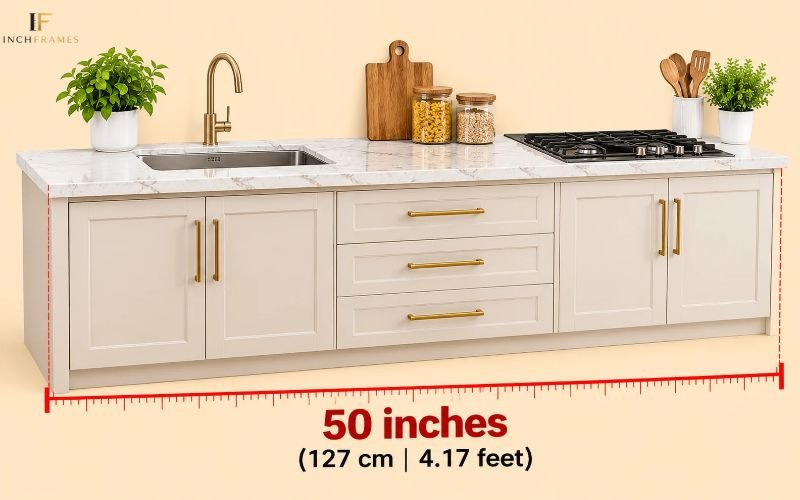
A 50-inch section of kitchen counter can help you picture the measurement in a very familiar setting. Imagine standing in front of a counter and measuring about 4 feet 2 inches from one point to another.
That is enough length for a useful section of workspace. You might have room for a cutting board, coffee maker, toaster, or other small kitchen items across that span.
Countertops are usually installed in longer runs, so a 50-inch section may be only part of the entire counter. That makes this comparison useful for understanding how a measurement can fit inside a larger object. You do not need a whole countertop to have a 50-inch length; a section of it can be enough.
Related Post: How Long Is 20 Feet? Compared to 15 Everyday Objects
Large Storage Shelf
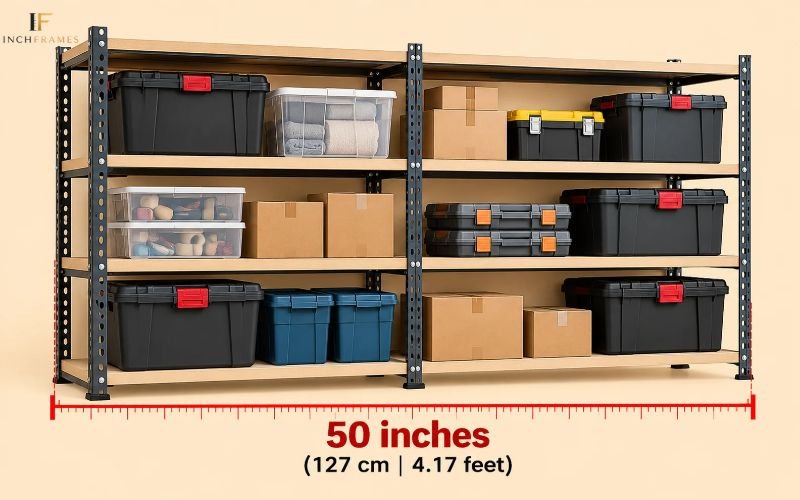
A large storage shelf around 48–50 inches wide can give you another practical reference. You might find shelves of this size in a garage, basement, utility room, or storage area.
Imagine standing in front of the shelf and stretching your arms across its width. A shelf that is close to 50 inches wide would cover a little more than 4 feet of wall space.
This size can be useful for storing boxes, tools, containers, cleaning supplies, or household items. The shelf’s depth will usually be much smaller than its width, so keep the measurement direction in mind when comparing it with 50 inches.
Folding Room Divider
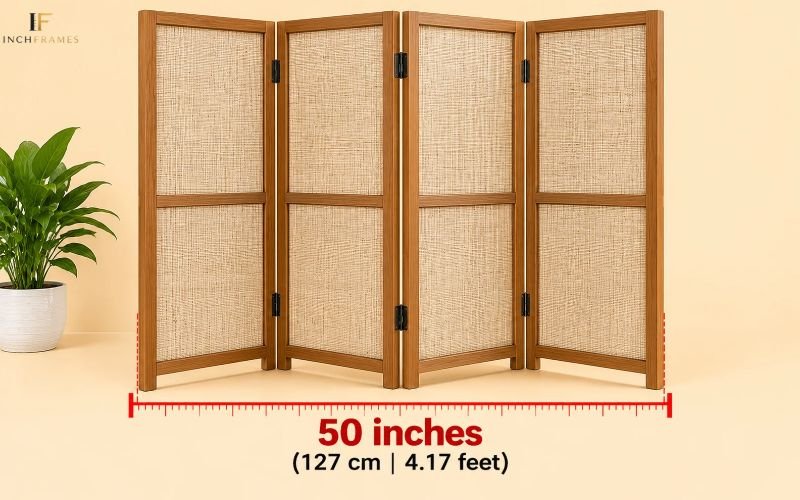
A folding room divider can have a total width close to 48–50 inches when its panels are opened, depending on the design. This makes it an interesting way to visualize 50 inches across a room.
Imagine unfolding the divider and looking at its full horizontal span. At around 50 inches, it would cover a little more than 4 feet of space. That is enough to create a noticeable visual separation between two areas.
Room dividers are often used in bedrooms, offices, studios, and shared spaces. Their flexible design also shows how a measurement can change depending on how an object is positioned.
How to Measure 50 Inches Without a Ruler
You can estimate 50 inches without carrying a ruler, although your result will not be exact.
Use four 1-foot sections plus 2 inches. Think of 50 inches as 4 feet and 2 inches. Mark four 1-foot sections in your mind, then add the extra 2 inches.
Use your walking pace. If you know your normal step is close to 2–3 feet, you can use a short series of steps to estimate a little over 4 feet. This works better on the ground than for small objects.
Use your hand span. Measure your hand span once with a ruler when you have one. If your span is around 8 inches, six spans would be roughly 48 inches, putting you very close to 50 inches.
Use a piece of string. Stretch a string across a known 4-foot space and add roughly 2 inches. You can then use that string as a quick reference.
What Does 50 Inches Look Like on a Wall?
A 50-inch measurement can take up a surprising amount of horizontal wall space. At 4 feet 2 inches, it is long enough to make a noticeable section of a wall without covering most of a typical room.
This matters when you are planning shelves, mirrors, artwork, televisions, or storage furniture. Before buying something listed as 50 inches wide, measure the actual wall space where you plan to put it.
Leave a little extra room around the object too. A shelf that is exactly 50 inches wide may technically fit into a 50-inch space, but installation can be difficult if there is no clearance.
Related Post: How Long Is 20 Inches? (Compared to 12 Everyday Objects)
Frequently Asked Questions
How many feet is 50 inches?
50 inches is 4 feet 2 inches, or about 4.17 feet. It is slightly longer than 4 feet.
How many centimeters is 50 inches?
50 inches equals exactly 127 centimeters. It is also 1.27 meters.
Is 50 inches the same as 4 feet?
No. Four feet is 48 inches. 50 inches is 2 inches longer than 4 feet.
Is 50 inches a long measurement?
For a household object, 50 inches is a fairly long measurement. It is just over 4 feet, so it can cover a large part of a table, shelf, bench, or similar object.
How can I picture 50 inches?
Think of a 4-foot bench with another 2 inches added. You can also picture a straight line that is 1.27 meters long.
How big is a 50-inch TV?
A 50-inch TV is measured diagonally from one corner of the screen to the opposite corner. The actual screen width is less than 50 inches and varies slightly by design.
Is 50 inches more than 1 meter?
Yes. One meter is about 39.37 inches, while 50 inches is 1.27 meters. So 50 inches is about 27 centimeters longer than 1 meter.
How many yards are 50 inches?
50 inches equals about 1.39 yards. Since one yard is 36 inches, 50 inches is one full yard plus 14 inches.
Final Remarks
50 inches is a little easier to understand when you stop treating it as just a number. It is 4 feet 2 inches, 127 centimeters, or 1.27 meters. That puts it in a useful middle range for many household measurements.
A four-foot bench, large shelf, ironing board, dining table, or similar object can help you picture the distance. Just remember that measurements can describe different directions. A 50-inch TV, for example, uses the diagonal rather than its straight width.
If you need an exact measurement, use a tape measure. For a quick estimate, though, thinking of 50 inches as four feet plus two inches is one of the simplest tricks to remember.
