
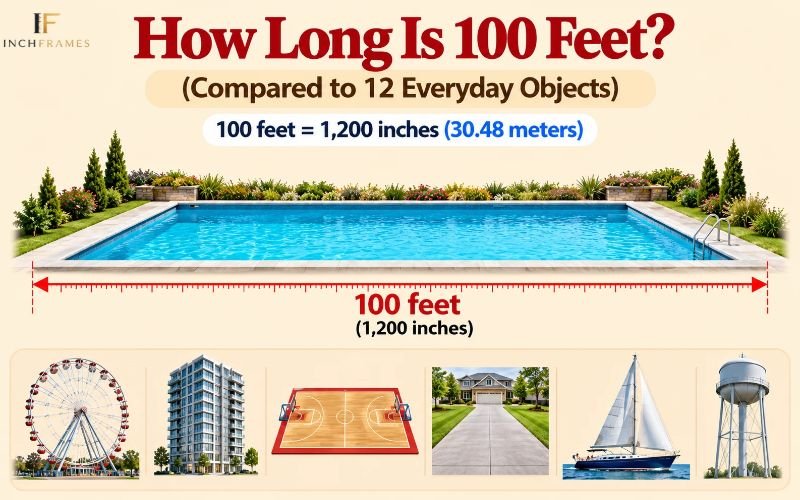
100 feet is equal to 1,200 inches, 33⅓ yards, or 30.48 meters. That makes it a fairly long distance for everyday life. If you stretched 100 feet in a straight line, it would be a little longer than a full-size basketball court.
The tricky part is that very few normal household objects are exactly 100 feet long. Most familiar things are much shorter, so the best way to picture 100 feet is by using large objects, buildings, and spaces that come close to this size. A tall 10-story building, a long property boundary, or a measured section of a park can give you a much better sense of scale than a collection of products sold in 100-foot lengths.
You can also think of 100 feet as a distance you could walk in roughly 35–40 ordinary steps. Once you connect the number to places and objects you have actually seen, how long is 100 feet becomes much easier to understand.
How Long Is 100 Feet, Really?
100 feet is 30.48 meters, so it is just over 30 meters long. If you were standing at one end, the other end would be far enough away to require a good look across an open area, but it would still be easy to see.
One useful comparison is a 30-meter swimming pool. Its length would be about 98.4 feet, just 1.6 feet short of 100 feet. Another simple reference is a 94-foot NBA basketball court. Add 6 feet to the court’s length and you have exactly 100 feet.
For a vertical picture, a building around 10 stories tall can sometimes reach roughly 100 feet, although the actual height depends on the building. So 100 feet can be understood both as a long distance across the ground and as a considerable height above you.
100 Feet in Real-World Use
A 100-foot distance can matter when you are working with a large outdoor space. For example, a homeowner might have a property boundary that is close to 100 feet long. A landscaper could also need to measure a similar distance when planning a lawn, walkway, fence, or irrigation layout.
Construction work is another place where distances around 100 feet can appear. Workers may measure from one part of a site to another when laying out foundations, utilities, access areas, or other features.
You can also encounter a 100-foot distance in recreation. A measured section of a park, training area, or swimming facility can give you a practical sense of what 100 feet looks and feels like.
The key is that 100 feet is large enough to matter when planning space, but not so large that you cannot easily see across it.
Everyday Things That Help You Picture 100 Feet
These everyday examples come from very different categories, making 100 feet easier to picture in real life.
Some are close to 100 feet, while others can reach about that size depending on their design.
Together, they give you a clearer visual sense of just how far 100 feet really is.
| Everyday reference | Approximate size |
|---|---|
| Swimming pool | 100 feet |
| 10-story building | 100 feet |
| NBA basketball court | 100 feet |
| Large residential property frontage | 100 feet |
| Long residential driveway | 100 feet |
| Ferris Wheel | 100 feet |
| Radio Tower | 100 feet |
| Large Sailboat | 100 feet |
| Long Water Slide | 100 feet |
| Water Tower | 100 feet |
| Large Grain Silo | 100 feet |
| Large Mature Tree | 100 feet |
Swimming Pool
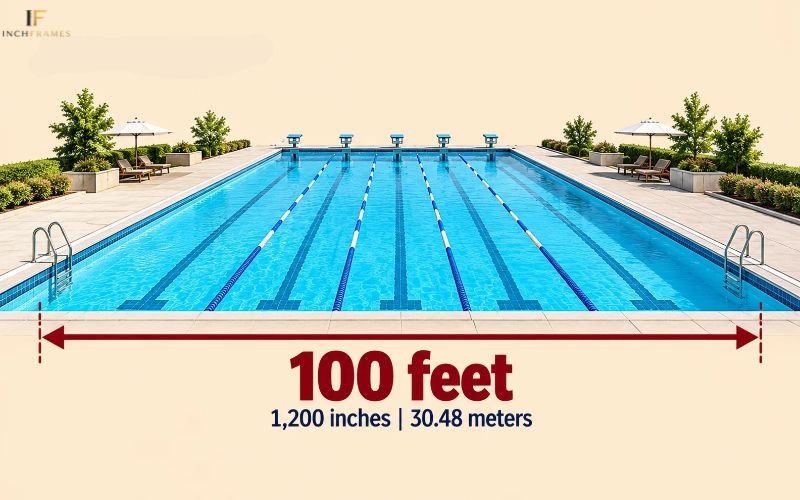
A swimming pool is one of the closest useful fixed references for 100 feet. A pool measuring 30 meters from one end to the other is 98.43 feet long, which is only about 1.57 feet shorter than 100 feet.
That makes it much more accurate than saying an ordinary backyard pool is 100 feet long. Most home pools are nowhere near this length.
Imagine standing at the shallow end of a 30-meter pool and looking toward the opposite end. The entire length would give you almost the same distance as 100 feet. You would need to add only about half a meter to reach the full 100 feet.
This is especially useful if you have seen a long training pool. Instead of picturing 100 feet as an abstract number, you can picture nearly 30 meters of water stretching straight ahead.
10-Story Building
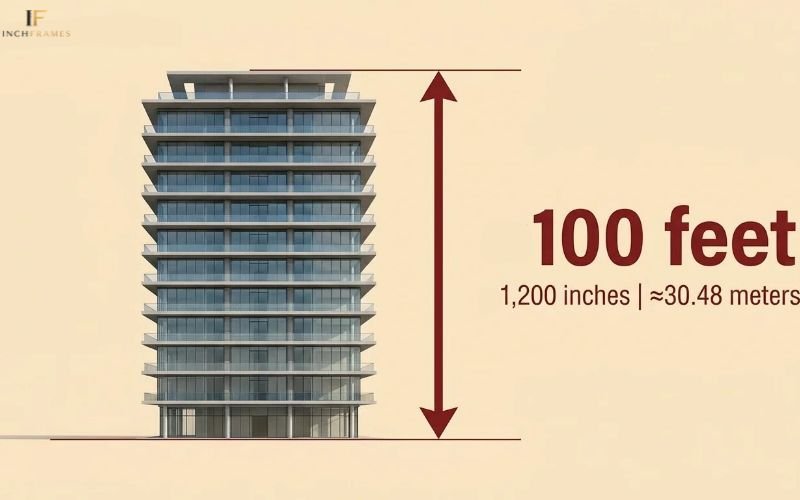
A building around 10 stories tall can provide a useful vertical picture of 100 feet. However, this is an approximation because floor heights vary between homes, offices, apartments, hotels, and other buildings.
A building with 10 floors might be around 100 feet tall when each floor and the roof structure add up to roughly 10 feet. Some buildings will be shorter, while others can be considerably taller.
What makes this reference useful is the way you experience it. Instead of imagining 100 feet lying flat on the ground, picture yourself standing at the bottom of a tall building and looking toward its roof.
If you are near a building of known height, you can use it as a rough visual guide. Just do not treat every 10-story building as exactly 100 feet. The number is best used as a scale reference, not an exact building measurement.
Related Post: How Long Is 90 Feet? (Compared to 15 Everyday Objects)
NBA Basketball Court
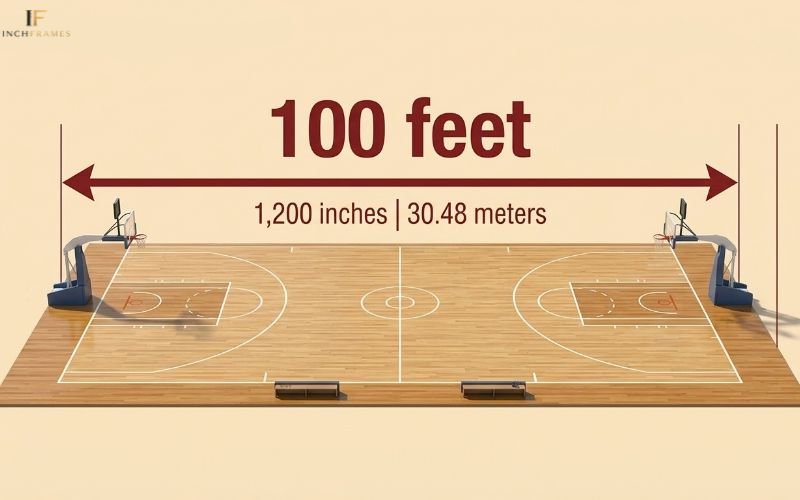
A regulation NBA basketball court is 94 feet long. That makes it an excellent starting point for understanding 100 feet.
To reach exactly 100 feet, imagine extending the court by another 6 feet beyond one baseline. That extra distance is about the length of a tall adult lying down or roughly two large walking steps, depending on the person.
If you have watched basketball in person, you have probably seen the full court from one end to the other. Walking its length already gives you a strong sense of the scale.
This comparison is particularly reliable because the court has a defined regulation length. Rather than claiming that a basketball court itself is 100 feet, you can picture the actual 94-foot court and then add 6 feet. Together, they give you the exact 100-foot distance.
Large Residential Property Frontage
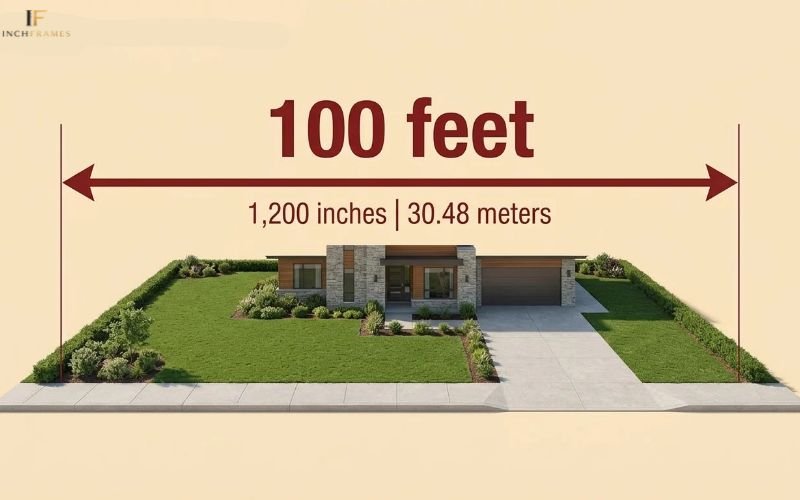
A property with 100 feet of frontage provides a practical example that many homeowners can understand. Property frontage is the distance along the front boundary, usually where the land meets a road or street.
If a property has 100 feet of frontage, walking in a straight line from one front corner to the other would cover exactly 100 feet.
The property itself could be much deeper or wider. For example, a rectangular property might have 100 feet of frontage but extend 150 feet or more toward the back. So the 100-foot measurement describes only that particular boundary.
This is a useful reference because property measurements are often shown in feet. When you see a listing that mentions 100 feet of frontage, you can now picture a straight boundary a little longer than a basketball court.
A Long Residential Driveway
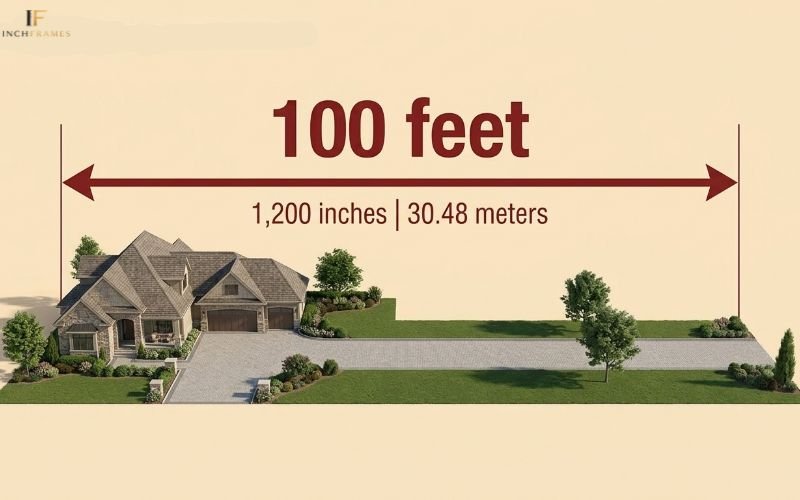
A 100-foot driveway is a useful real-world example, especially for homes on larger lots. It would run from the road to the house or another entrance for a considerable distance.
Not every long driveway is 100 feet, of course. Some are much shorter, while rural and large-lot properties can have driveways several hundred feet long. That is why this works best as an example of what a measured 100-foot driveway looks like rather than a claim that residential driveways normally have this length.
Imagine parking your car at the road and having the house another 100 feet away. You would have a noticeable walk before reaching the front door.
A driveway this long also gives you a sense of how much space a 100-foot line takes up on a residential property.
Related Post: How Long Is 80 Feet? (Compared to 14 Everyday Objects)
Ferris Wheel
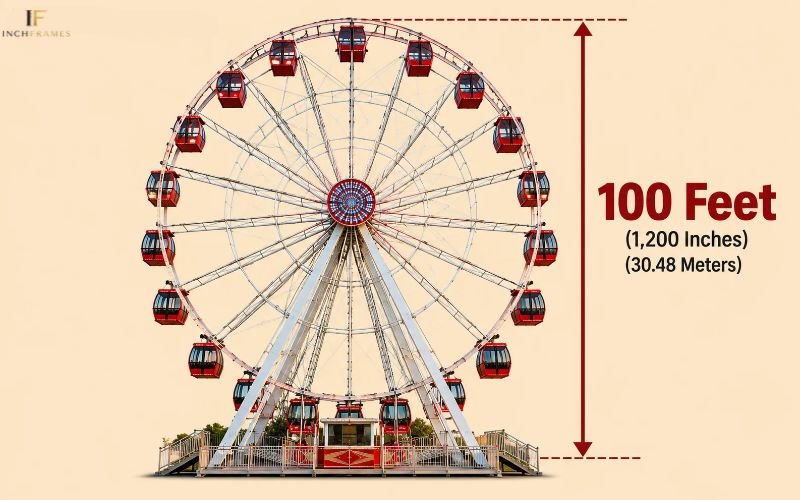
A Ferris wheel around 100 feet tall gives you a memorable way to understand 100 feet as a vertical distance. Ferris wheels are built in many sizes, so some are much smaller while others are considerably larger.
A wheel close to 100 feet can be found at larger fairs, amusement parks, and traveling carnivals. Stand beside the ride and look toward its highest point. The top would be roughly 100 feet above the ground.
The circular shape also makes the comparison easy to understand because the full height is visible from a distance. You can picture the same 100 feet stretching from the ground to the top of the ride.
For someone who has been to a fair, this is often easier to imagine than a plain number written on a measuring tape.
Radio Tower
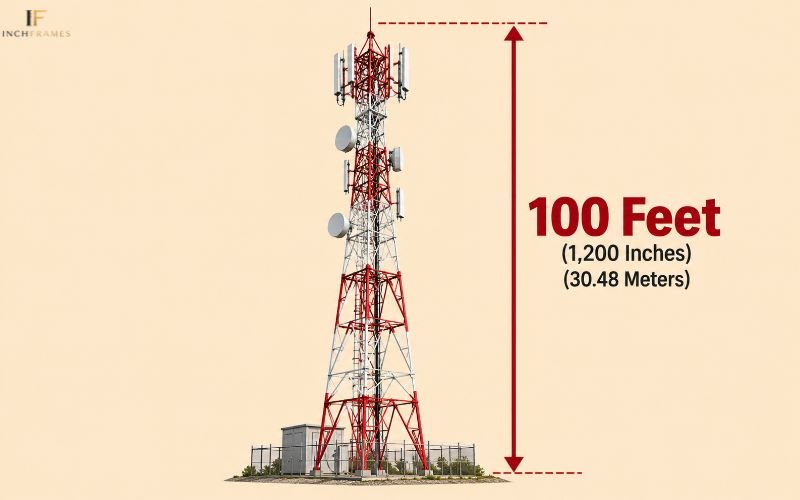
A radio tower around 100 feet tall gives you another clear example of 100 feet rising upward. Communication towers vary widely in size, but one close to 100 feet is tall enough to stand noticeably above many homes and nearby trees.
Imagine standing at the tower’s base and following its metal framework all the way to the antenna at the top. That upward distance would be roughly 100 feet.
Radio towers are often narrow, which makes their height easy to notice. You can usually see the entire structure against the sky rather than seeing only part of it behind a large building.
You may come across towers like these near communication facilities, industrial areas, or rural locations. They show that 100 feet is a substantial height even though the structure itself may take up very little ground space.
Large Sailboat
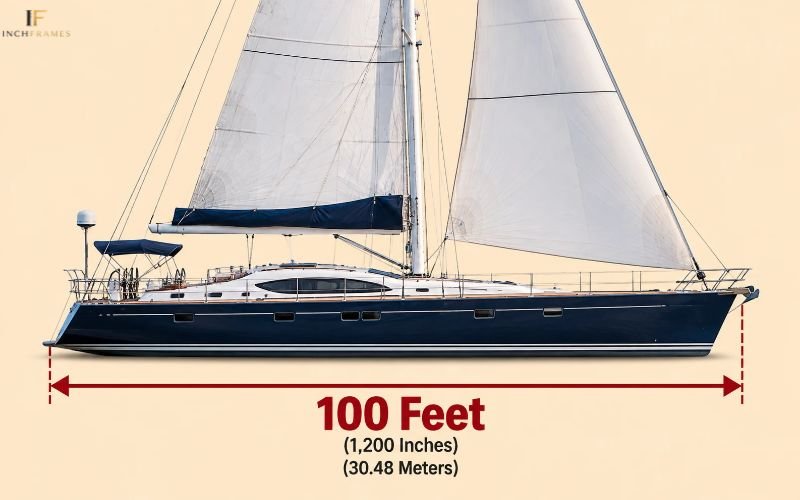
A large sailboat around 100 feet long gives you a useful horizontal comparison. Sailboats range from small recreational boats to very large ocean-going vessels, so this example represents a larger boat rather than an ordinary small sailboat.
On a vessel close to 100 feet from bow to stern, walking from the front of the boat to the back would cover almost the same distance as walking a straight 100-foot line on land.
Boats of this size are more likely to be seen at major marinas, yacht harbors, and sailing events. Compared with a small sailboat used for casual trips, one measuring around 100 feet would look enormous.
The boat is also easy to visualize because its length forms one continuous object. You can mentally trace the distance from the pointed bow all the way to the stern.
Long Water Slide
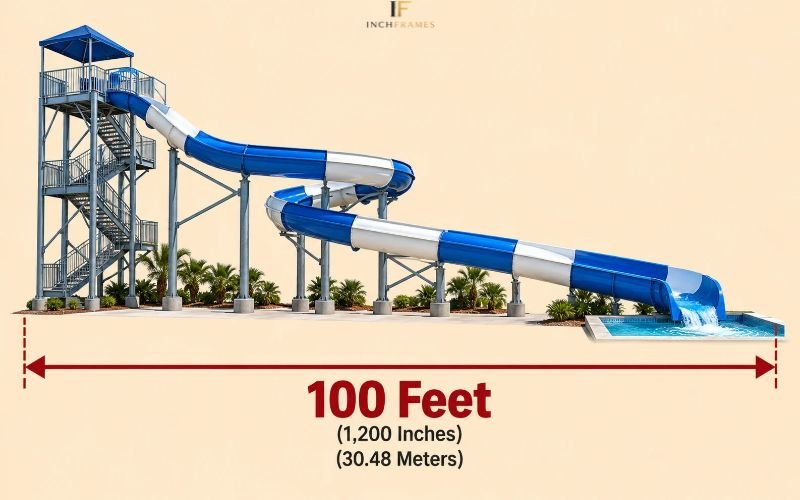
A water slide around 100 feet long is a fun way to picture the measurement because the full length is designed for one continuous ride. Large water parks have slides of many different lengths, shapes, and heights.
Some slides curve, twist, or drop down from tall platforms, so the actual length depends on the individual design. A slide around 100 feet long would stretch about 30.48 meters if its full length were laid out for measurement.
When you are riding one, it can be difficult to judge the distance because the slide keeps changing direction. Looking at a long slide from outside gives you a better sense of its total size.
Imagine straightening that entire slide into one line. You would have a path about 100 feet long, which is a surprisingly large distance for a single amusement attraction.
Water Tower
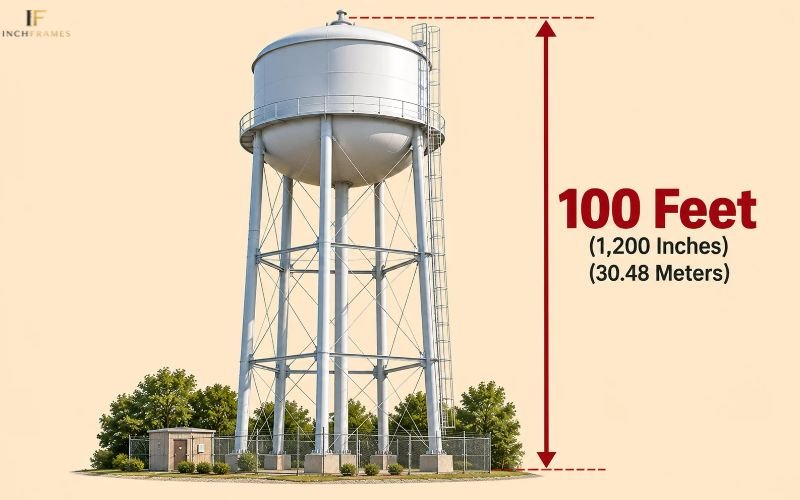
A water tower around 100 feet tall is another useful structure for understanding this measurement. Water towers come in many shapes and heights, but some large municipal towers can reach around this height.
Imagine standing underneath the tank and looking toward its highest point. A structure close to 100 feet would tower above nearby homes and most ordinary buildings.
Water towers are especially helpful as a reference because their elevated tanks are easy to spot from a distance. You do not have to stand right beside one to appreciate its size. The large tank and supporting structure make the height very noticeable.
You may see similar towers near towns, industrial areas, or water facilities. They are a good reminder that 100 feet can reach much higher than most things people encounter around a typical home.
Related Post: How Long Is 70 Feet? Compared to 15 Everyday Objects
Large Grain Silo
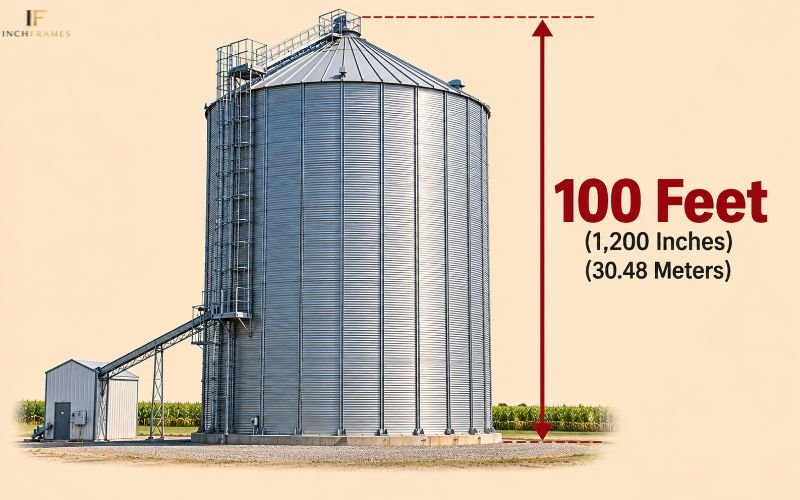
A large grain silo around 100 feet tall gives you a useful agricultural reference for 100 feet. Silos are used to store grain, feed, and other bulk materials, and their size varies depending on their purpose and capacity.
A large silo near 100 feet would be noticeably taller than most farm buildings. Standing at its base and looking toward the top gives you the same basic visual as looking up a 100-foot tower.
The cylindrical shape makes the height easy to judge because the structure usually rises straight upward without many changes along its side. You can clearly see where it begins and where it ends.
Large silos are most common around farms, grain facilities, and agricultural processing sites. They are not something everyone sees every day, but when you do see one, its height can make the scale of 100 feet much easier to understand.
Large Mature Tree
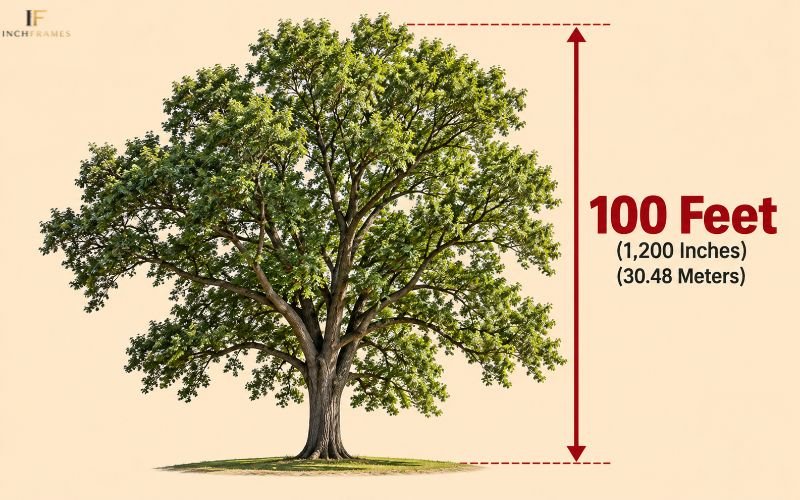
A large mature tree around 100 feet tall can give you a natural reference for how far 100 feet extends into the sky. Many common trees are much shorter, so a tree reaching this height would usually be a large, mature specimen.
Picture yourself standing beside the trunk and looking through the branches toward the highest leaves. A tree close to 100 feet would rise well above most houses and smaller trees around it.
You may find very tall trees in forests, large parks, botanical gardens, and older wooded areas. The exact height depends on the species and growing conditions, so not every mature tree comes close to 100 feet.
Still, a tree of this size creates a strong mental image. Instead of thinking about 100 feet as a measurement on a page, you can picture the distance rising naturally from the ground to the tree’s highest branches.
How to Measure 100 Feet Without a Ruler
You can estimate 100 feet without carrying a 100-foot tape, but the result will not be exact.
Use your steps: For many adults, a normal walking step is roughly 2.5–3 feet. That puts 100 feet at around 35–40 steps. Walk normally rather than taking unusually large strides.
Use a 10-foot reference: If you can measure 10 feet once, mark that distance and repeat it 10 times. Ten sections of 10 feet equal exactly 100 feet.
Use a 30-meter reference: Since 100 feet equals 30.48 meters, a measured 30-meter distance gets you very close. You would need another 48 centimeters to reach 100 feet.
Use a known court: A regulation NBA court is 94 feet long. Walking its full length and adding 6 feet gives you 100 feet.
For anything involving property, construction, or exact placement, confirm your estimate with a proper measuring tool.
How Much Space Does 100 Feet Cover?
100 feet can cover a surprisingly large part of an open area. If you draw a straight 100-foot line across a yard, field, or park, it will be easy to recognize as a substantial distance.
It is also useful to remember that 100 feet is only one dimension. A space that is 100 feet long might be narrow, while another space could be 100 feet long and 100 feet wide. The second space would be far larger overall.
For example, a 100-by-100-foot area contains 10,000 square feet. That is very different from simply having a 100-foot boundary.
So when someone says a space is “100 feet,” ask what is being measured: length, width, height, or boundary distance. That small detail can change the meaning quite a bit.
Related Post: 12 Everyday Things That Are 18 Inches Long
Frequently Asked Questions
How long is 100 feet in inches?
100 feet equals 1,200 inches. You get this by multiplying 100 feet by 12 inches per foot.
How long is 100 feet in meters?
100 feet equals 30.48 meters. For a quick everyday estimate, you can round this to about 30.5 meters.
How many yards are in 100 feet?
100 feet equals 33⅓ yards. Since one yard is 3 feet, 100 divided by 3 gives 33.33 yards.
Is 100 feet longer than a basketball court?
Yes. An NBA basketball court is 94 feet long, so 100 feet is 6 feet longer. This makes a basketball court one of the most useful familiar references for the distance.
How many steps is 100 feet?
For many people, 100 feet takes about 35–40 normal walking steps. Your actual number depends on your stride length.
Is 100 feet a long distance?
For everyday objects and spaces, 100 feet is a fairly long distance. It is a little longer than an NBA basketball court and measures 30.48 meters from end to end.
How far is 100 feet compared with 30 meters?
100 feet is 30.48 meters, so it is 48 centimeters longer than 30 meters. The two measurements are close enough that 30 meters can be a useful rough visual reference.
What is an easy way to picture 100 feet?
Picture an NBA basketball court and add 6 feet to its length. Another option is to imagine walking roughly 35–40 normal steps in a straight line.
Final Remarks
100 feet is 1,200 inches, 33⅓ yards, and 30.48 meters. It is a substantial distance, but it is still easy to picture once you connect it with familiar spaces. A 30-meter pool is almost exactly 100 feet, while an NBA basketball court gets you to 94 feet and needs only 6 more feet.
For property work, landscaping, construction, or outdoor planning, a 100-foot line can cover a large part of the space you are working with. If you only need a rough idea, walking about 35–40 normal steps is a useful starting point.
When accuracy matters, though, don’t rely on your eyes or footsteps alone. Mark the distance with a proper tape or measuring tool. That small extra step can prevent a surprisingly large mistake.
